Also in Theaters:The Secret Agent and Hamnet, which continue their respective runs at Cinemapolis, obviously remain my top new movie recommendations. In addition to the titles listed above, I’m also still hoping to catch The Housemaid before it closes at the Regal. It’s another quiet week on the special events front, but noteworthy repertory options include John Wick at the Regal today, Ghostbusters there on Monday, and Mission: Impossible there on Tuesday.
Home Video Recommendation: New Year’s Day is a time for resolutions, but not everyone is actually going to change. The Conformist, which current Cornell faculty, staff, and students can view on Kanopy courtesy a license paid for by the library and which is available for rental on a variety of other platforms, is perhaps therefore not as incongruous a title to mention here as it may first seem. Here’s what I recently said about it on Letterboxd:
All surfaces, often literally–the camera will suddenly rack focus in the middle of a conversation between the occupants of a car to make sure we don’t miss its idle windshield wipers–and noteworthy less for any grand statement you want to read into it than the poetry of its constituent parts, such as a servant sneaking bites of spaghetti out of the bowl she just served her employers from, a low-angle tracking shot toward a car through giant fallen leaves blown by wind nowhere to be found earlier in the scene, and a blue sky baby room wall that says “yes, and . . . ” to the acres of marble which preceded it.
Previous “Ithaca Film Journal” posts canbe found here.A running list ofall of my “Home Video” recommendations can be found here.
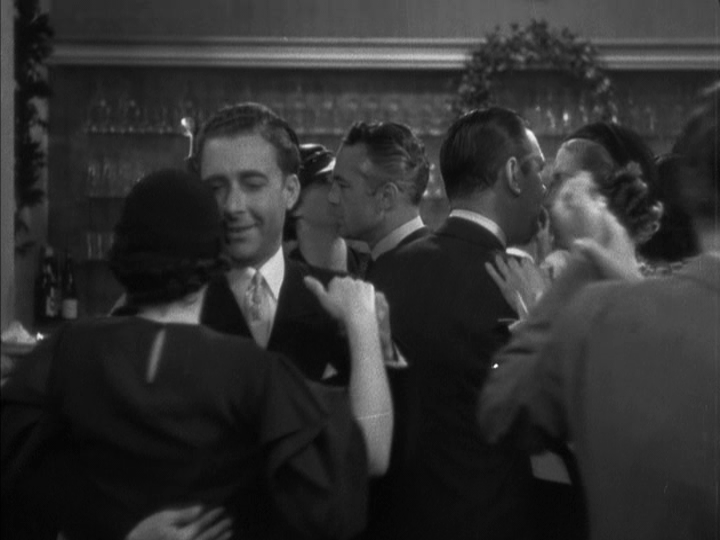
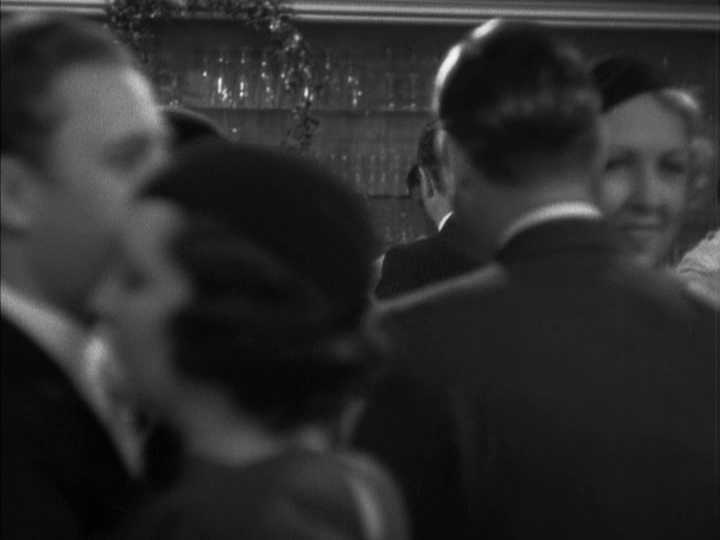
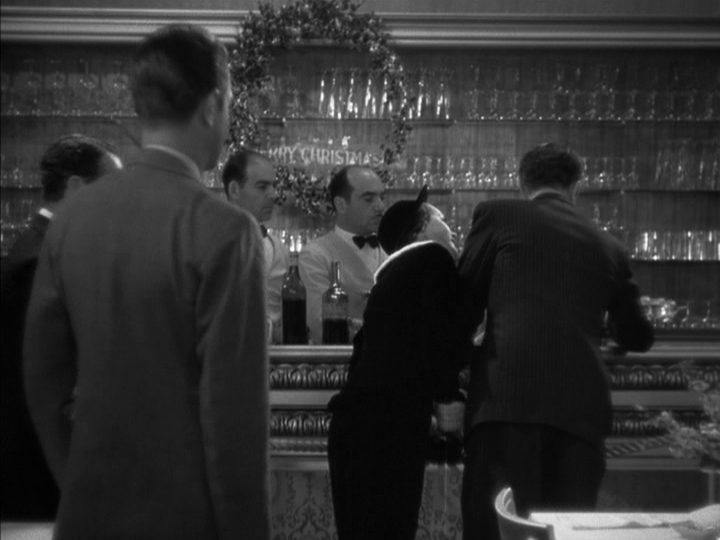
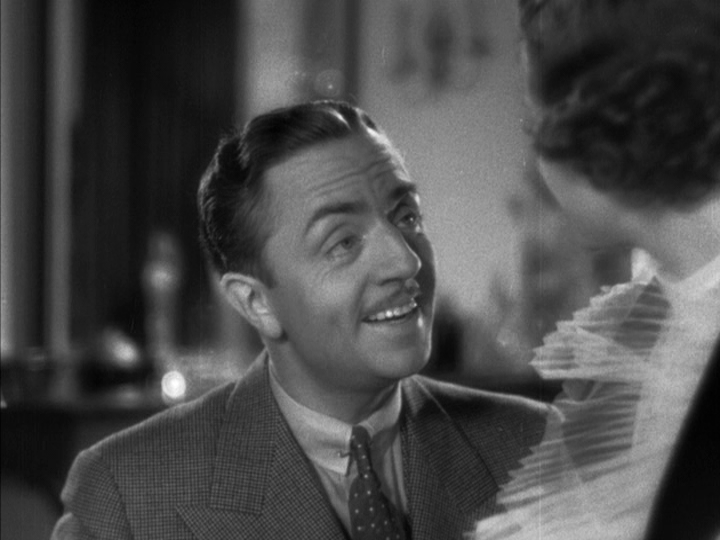
I started this series four years ago as a way to get back into the habit of regular writing. It proved to be so effective that by July I had made up my mind to keep it going through 2025 and supplement it with enough “bonus” posts to give me the equivalent of a year-long weekly film series. Eventually it occurred to me that if I added one more, I could edit everything into a self-published book complete with an introduction, and when I created a two-column landing page a 54th became inevitable. But now after 95,940 words and 1,746 screengrabs, we have finally reached the finish line! We end as we must with the most canonical drink I haven’t yet written about, the Martini. I’m pairing it with The Thin Man and the screen couple who may well be responsible for James Bond’s outdated impression that it’s supposed to be shaken instead of stirred, Nick (William Powell) and Nora (Myrna Loy) Charles. After all, that’s how Nick is preparing one when we first meet him at the end of a 50-second-long tracking shot that makes its way through a crowded dance floor before coming to rest on our hero:
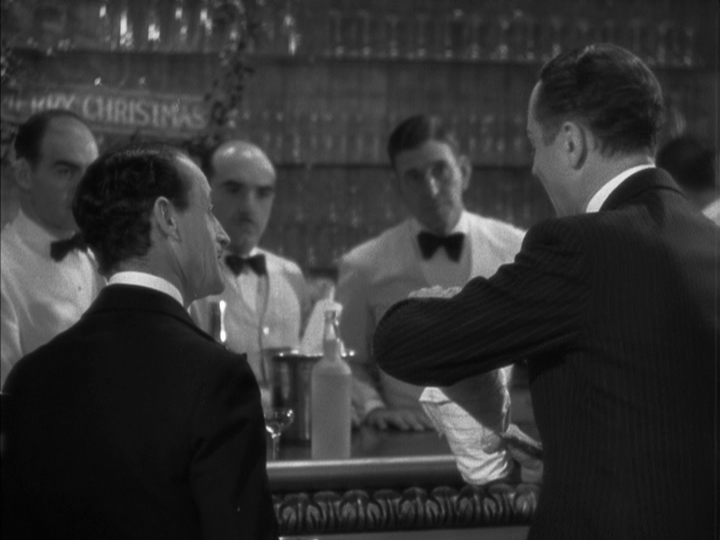
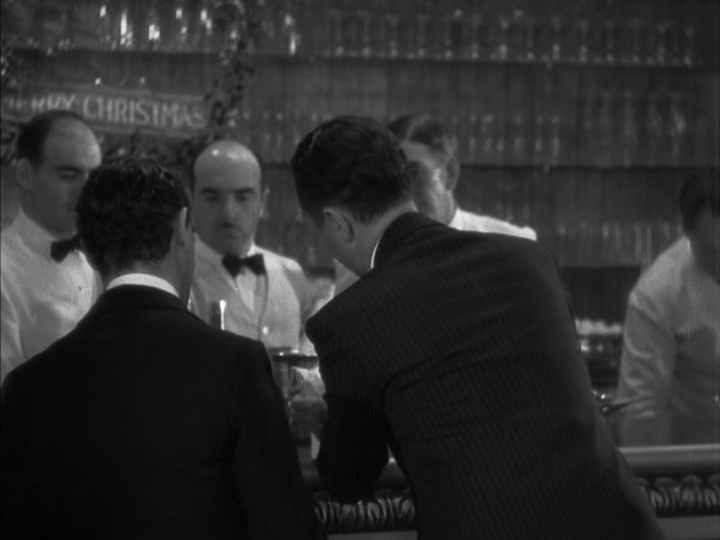
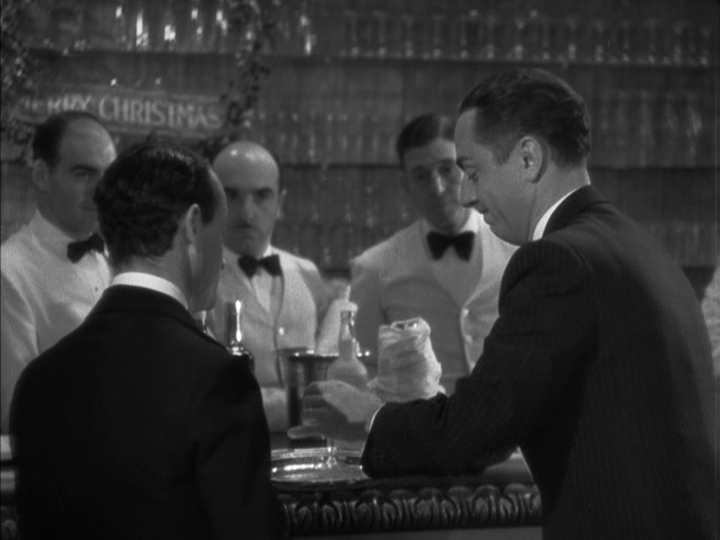
“You should always have rhythm in your shaking,” he tells the bartenders who watch him, rapt. “Now, a Manhattan you shake to foxtrot time.” He begins to strain the concoction into a glass:
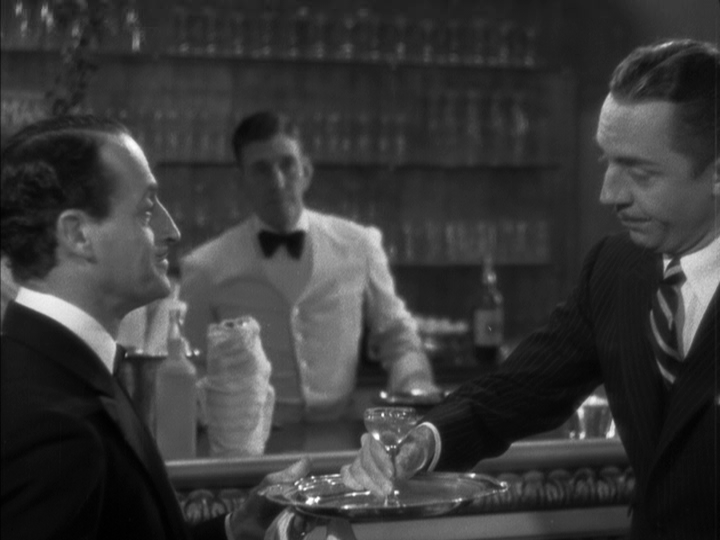
“A Bronx to two-step time,” he continues, placing the drink on a tray:
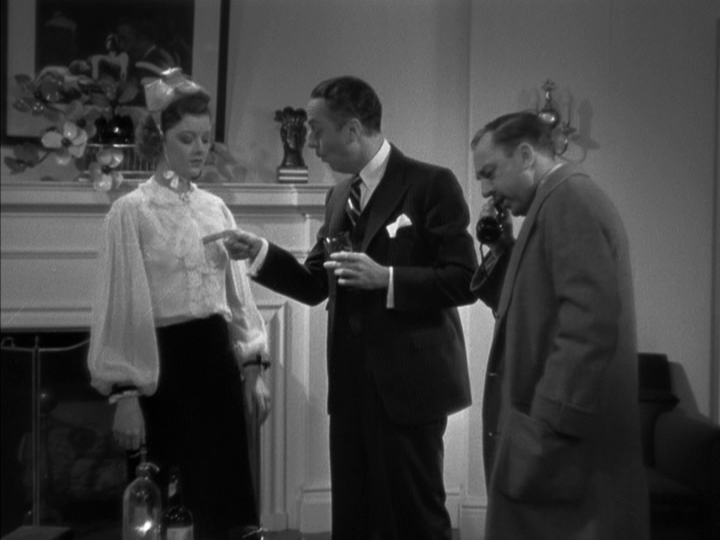
“The dry Martini you always shake to waltz time,” he concludes. Which: this *would* guarantee that the shaking is done gently, limiting aeration and dilution to acceptable levels, and I don’t think a barspoon is capable of anywhere near the same degree of bespoke sophistication, so maybe the technique is overdue for a revival! The Martini proportions in The PDT Cocktail Book are perfect as far as I’m concerned, but in a nod to the Christmas season (which is when The Thin Man takes place) we’ve been making ours with a dash of an extra ingredient and a festive garnish. Here’s how:
Stir all ingredients with ice and strain into a chilled Nick & Nora (of course!) glass. Garnish with three fermented Christmas cranberries on a cocktail pick.
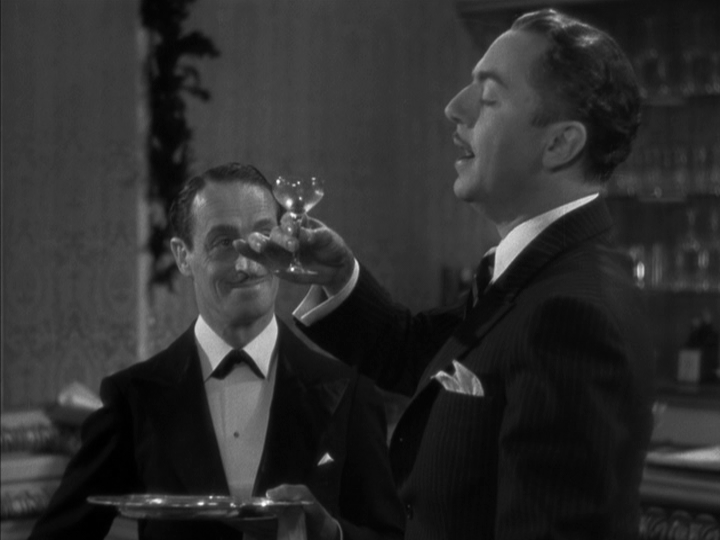
Élixir Végétal de la Grande-Chartreuse is the original product that its more famous descendants green and yellow Chartreuse are based on and a little goes a very long way. Here it contributes distinctive herbal notes to the nose and sip and, just as important for our purposes, a pale but pronounced green color that contrasts beautifully with the brick red garnish. The cranberries, in turn, provide just the slightest bit of effervescence, which accentuate the citrus notes of the Plymouth, but fear not: everyone we’ve served this to agrees that the little surprises we’ve added know their place and that our version has the classic finish of the one Nick proceeds to serve himself:
And savor:
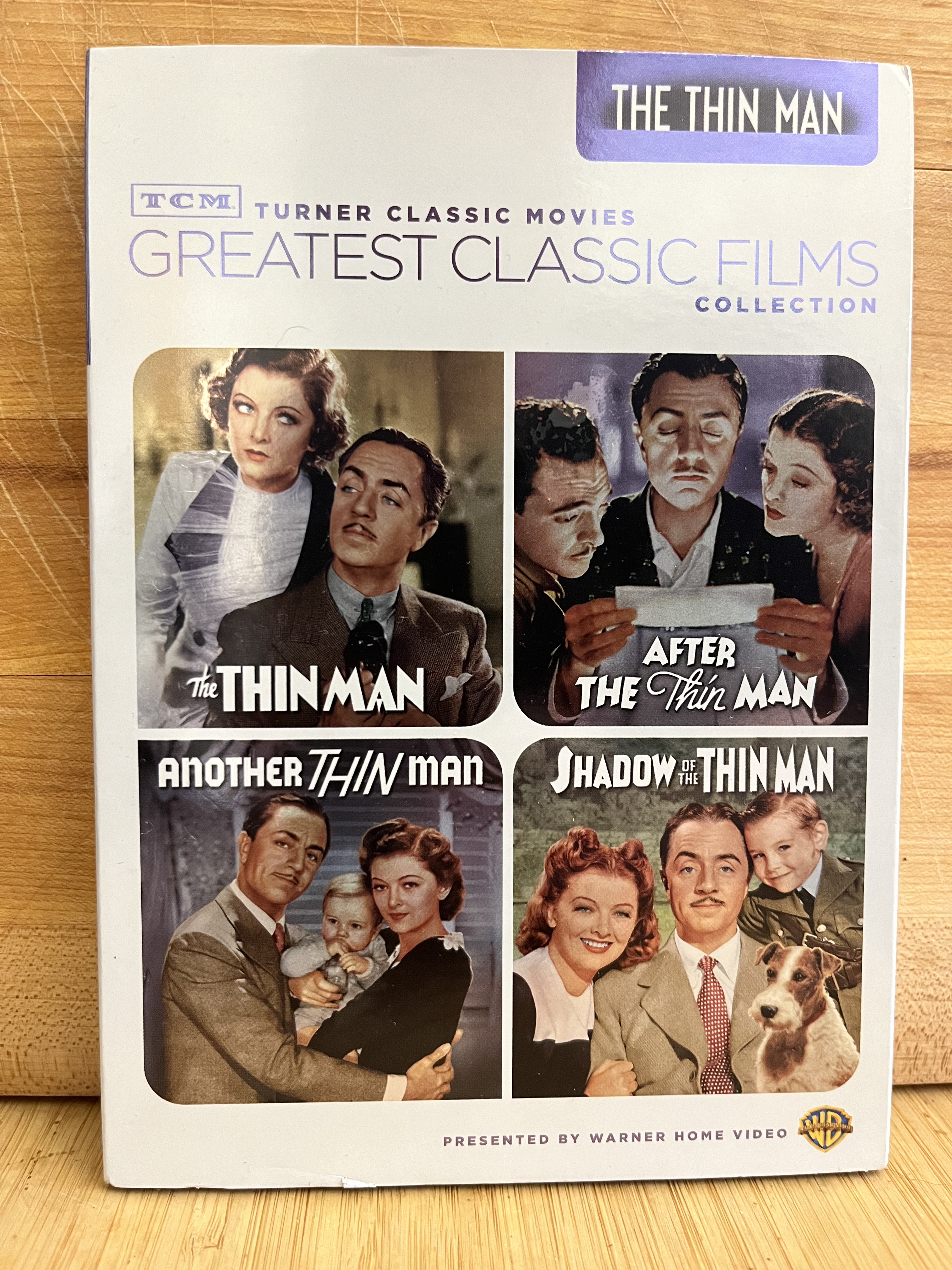
The images in this post all come from my TCM Greatest Classic Films Collection box set which includes the first three Thin Man sequels, too:
The original can also be streamed on Tubi for free if you don’t mind commercial breaks or rented and purchased from a variety of platforms if you do.
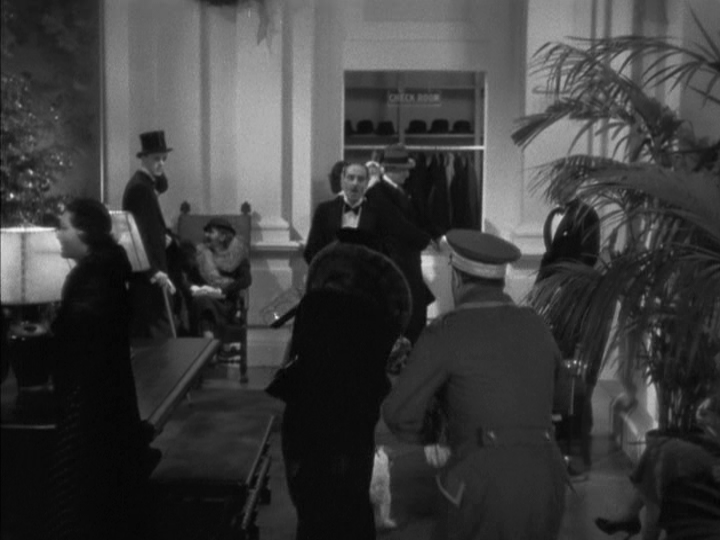
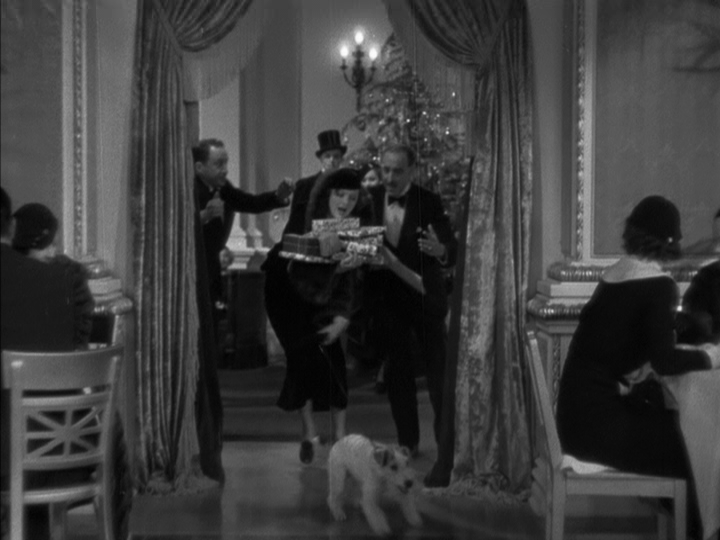
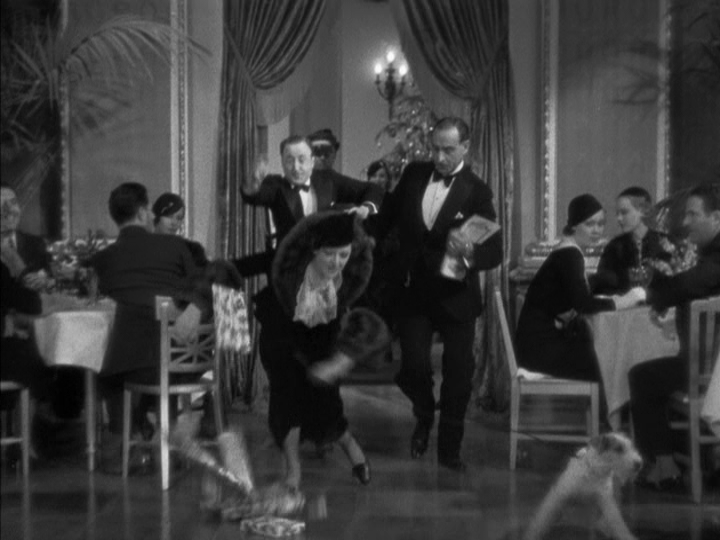
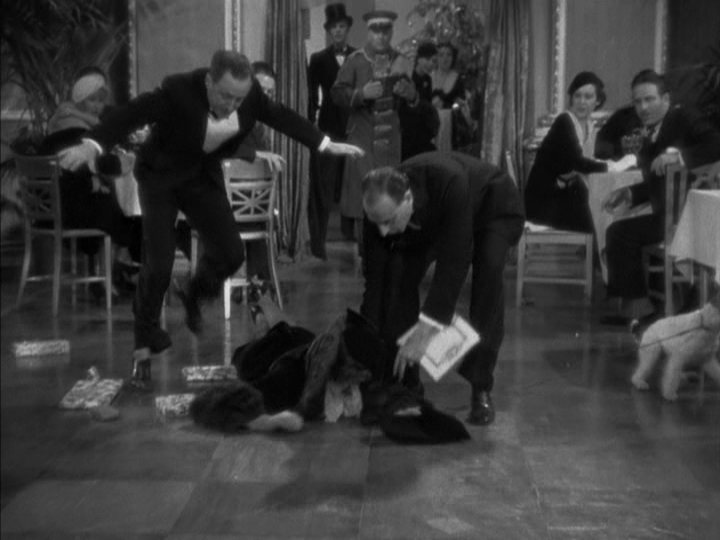
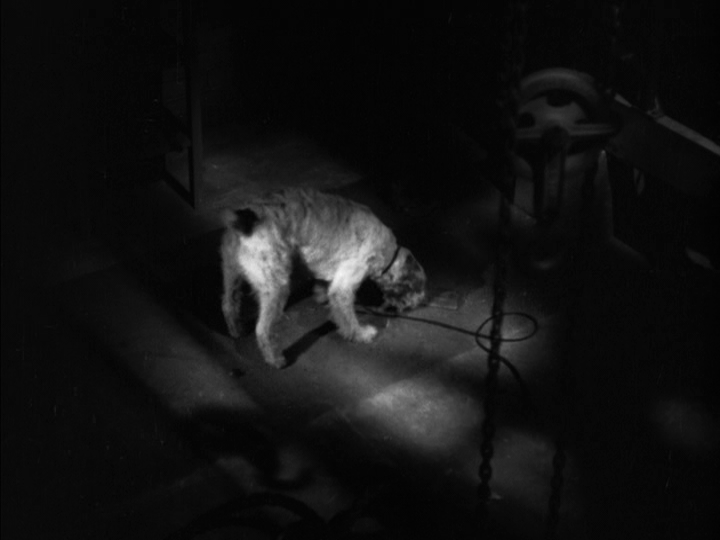
Martha Nochimson argues in her book Screen Couple Chemistry: The Power of 2that The Thin Man “is not structured by Hollywood’s familiar gender formula: woman/body–man/mind.” She submits as evidence the fact that both Nick and Nora first appear from behind, him in the mixing ritual depicted above which “requires an atypical male absorption in his body,” while her entrance behind their dog Asta “uses the cliche of female closeness to animality and body to make a joke of Hollywood’s traditional images of female glamour”:
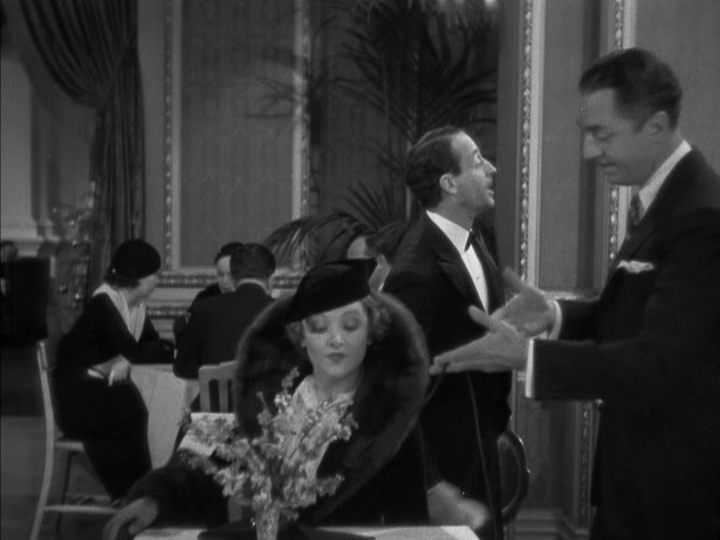
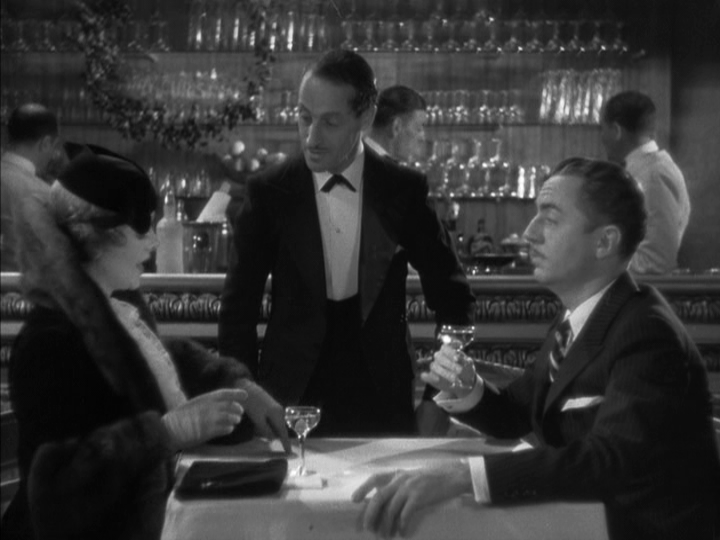
As Rob Kozlowski describes it in his book Becoming Nick and Nora, their first conversation “takes place over the course of a single, forty-seven-second shot” that has nothing to do with the murder mystery that the film is ostensibly about “but everything to do with showing us this marvelous relationship.” It is preceded by Nick, who is visibly but amiably tipsy throughout this scene and much of the movie, forgetting the word “cocktail” but still managing to make himself understood to a waiter as he invites Nora to sit down and join him in one:
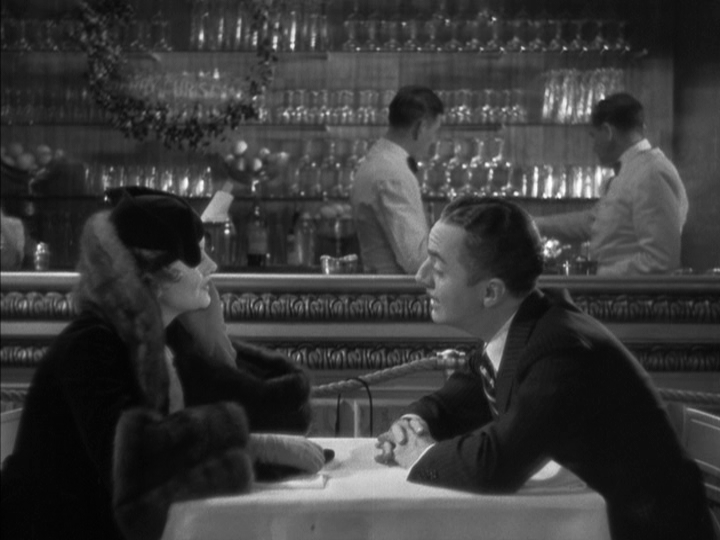
The long take which follows is, per Kozlowski, “very economical,” but also “absolutely the correct approach from a narrative standpoint”:
Because:
By holding both Nick and Nora in the frame, we’re able to see them both speaking, and both listening, at the same time. Nora, adorned in a fur coat with her chin resting in her hand, perpetually amused by the sight of her besotted and blotto husband, has her focus entirely on him. Nick, with his arms resting on the table, his hands inches away from hers, has his focus entirely on her.”
The scene ends with Nora asking Nick how many he has had. “Six martinis,” he replies. Her response is to immediately order five more to catch up, which to Kozlowski captures the essence of what makes theirs “the friendliest, most fun marriage ever captured on screen.”
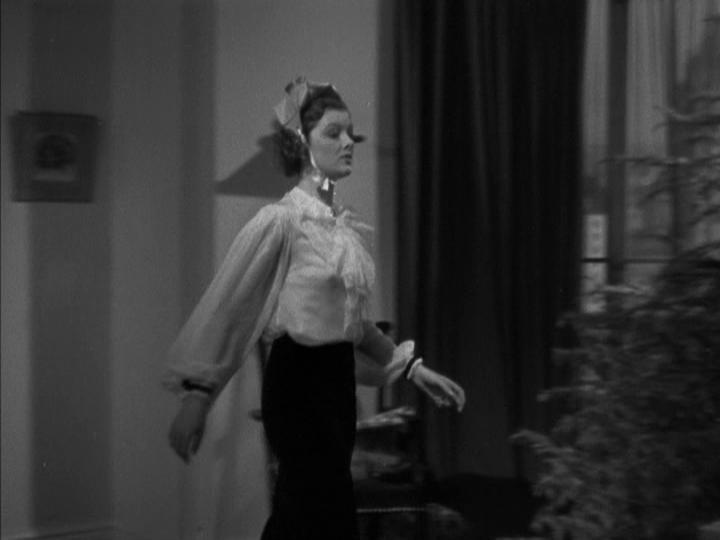
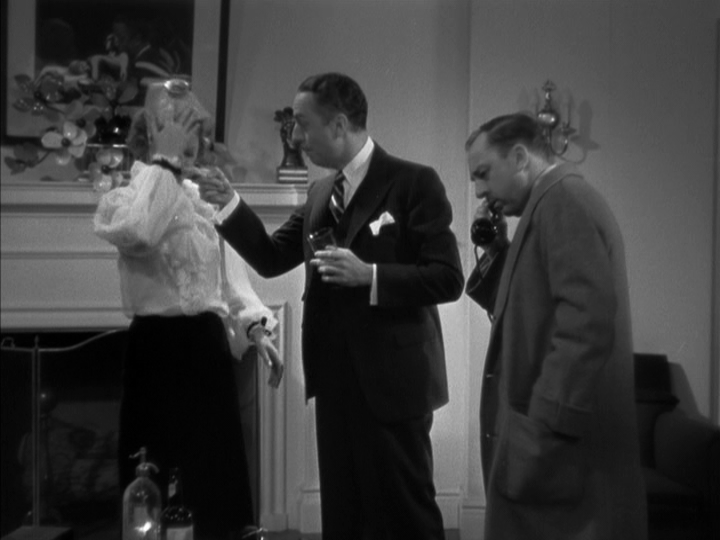
“They’re almost always playing,” he explains, “and they’re equals on top of it all.” Nochimson agrees with him about this sequence, which she calls paradoxically “both archly witty and genuinely earthy,” but also notes that while “time has veiled Nick and Nora in sentimental nostalgia,” upon closer inspection “their abrasive qualities burst off the screen.” In a not-quite-but-almost-acknowledgement of the darker side of drinking, the latter wakes up the following morning with a hangover (instead of alcohol poisoning, which might be more realistic), but rather than make her more relatable, the ice bag she wears like an elegant hat only serves to reinforce Nochimson’s description of her as “tall, slim, condescending, and always appareled in stunning, regal, intricately designed and infuriating (for those in the audience who will never be able to afford such things) ‘outfits'” who “stands with that ramrod carriage that summons images of young girls schooled relentlessly in balancing books on their heads”:
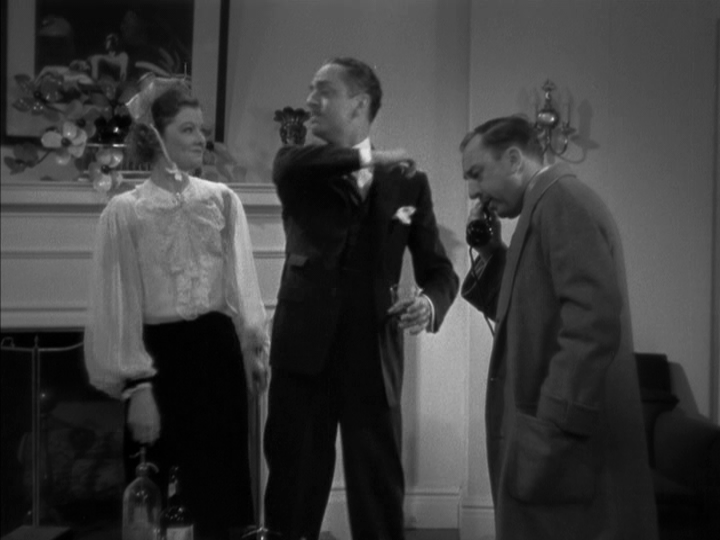
Meanwhile Nick, whose speech is already beginning to slur from what appears to be a breakfast of Scotch and soda, does indeed have “the loose-jointed bearing of a man just about to fall into a heap” as he first flicks her nose:
Then pantomimes smacking her in retribution for a well-deserved slap on the back of the head:
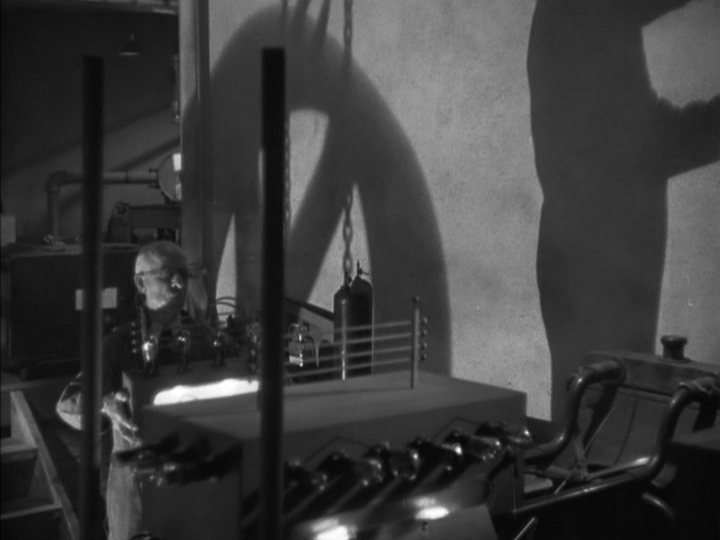
The man on the phone in the foreground is Herbert MacCaulay (Porter Hall), lawyer to inventor Clyde Wynant (Edward Ellis), who we see here working in his laboratory:
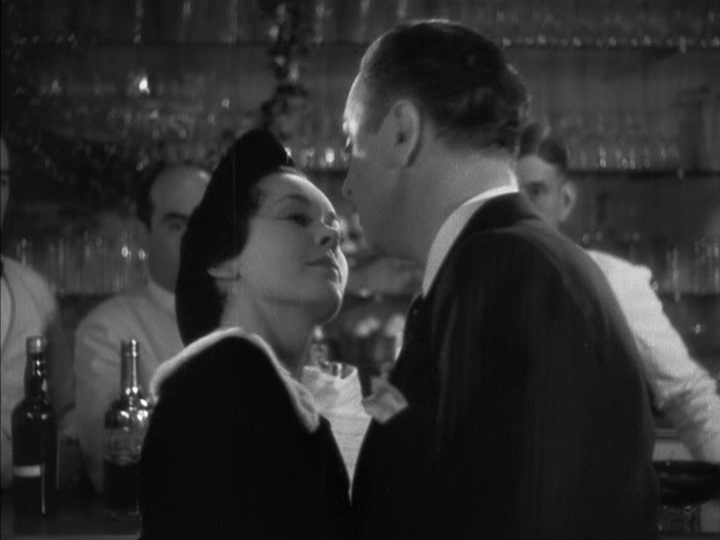
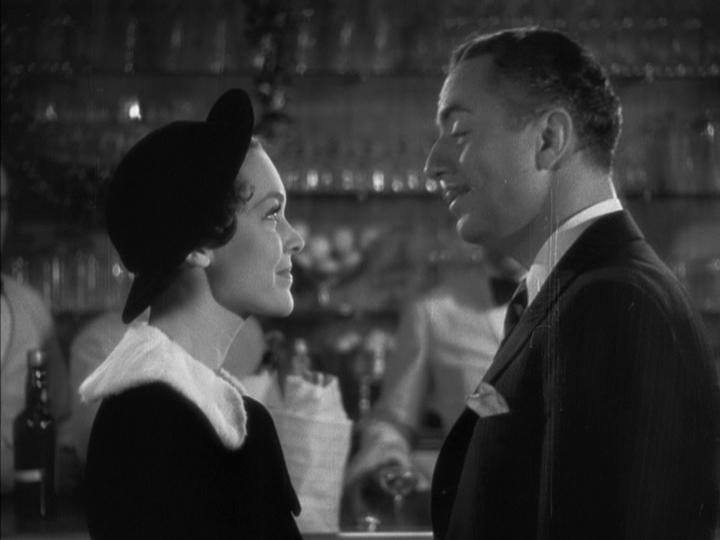
And the mixology lesson we started this post with was interrupted by Wynant’s daughter Dorothy (Maureen O’Sullivan), who remembers Nick, a former private detective, from a case he worked on for her father in her youth:
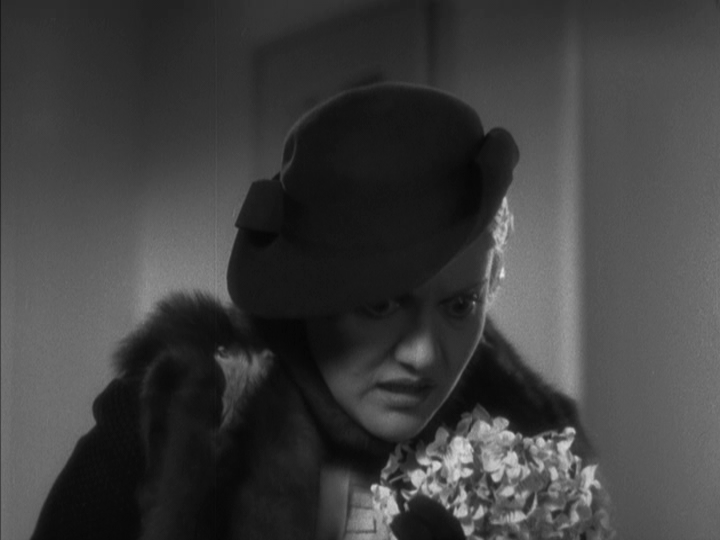
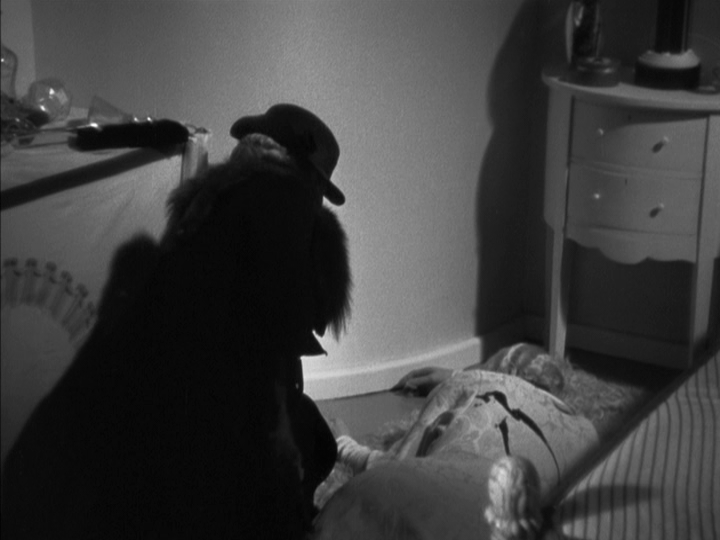
You see, Clyde has disappeared. Or maybe he hasn’t: the phone call MacCaulay takes informs him that Wynant is back in town and wants to meet. Except that Wynant doesn’t show, and in the meantime his secretary-cum-mistress Julia Wolf (Natalie Moorhead) turns up dead. Coincidentally, she had just agreed to meet Wynant’s ex-wife Mimi Jorgenson (Minna Gombell), Dorothy’s mother, who upon discovering the body first screams:
But then makes a face and leans forward to remove something from the crime scene:
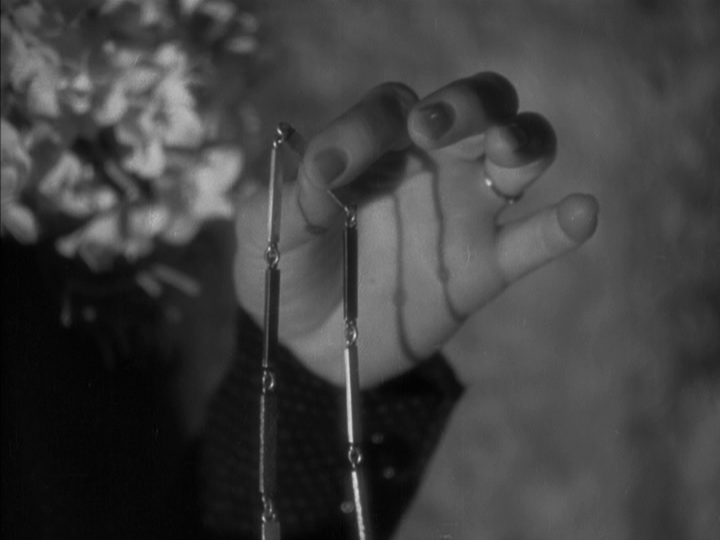
After she later reveals to Dorothy, who suspects her mother of robbing Wolf, that what she took was a metal chain known to belong to Wynant:
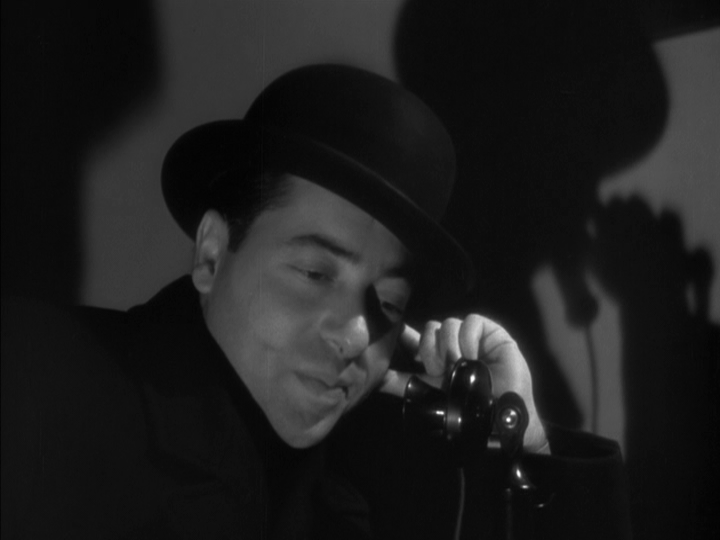
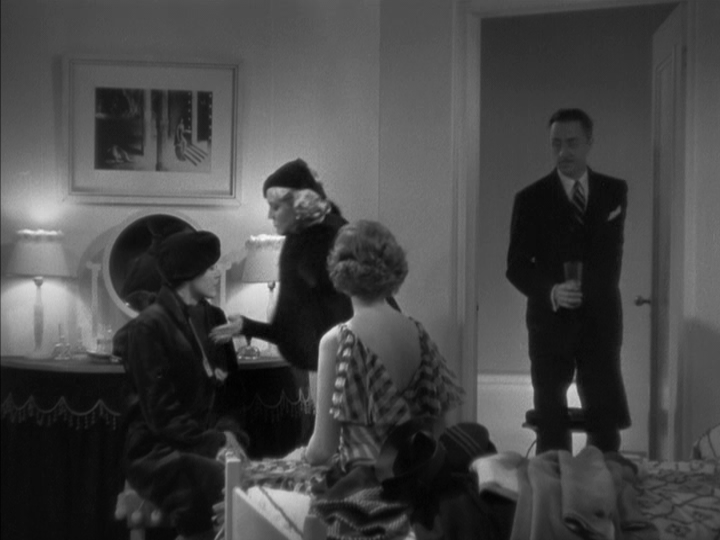
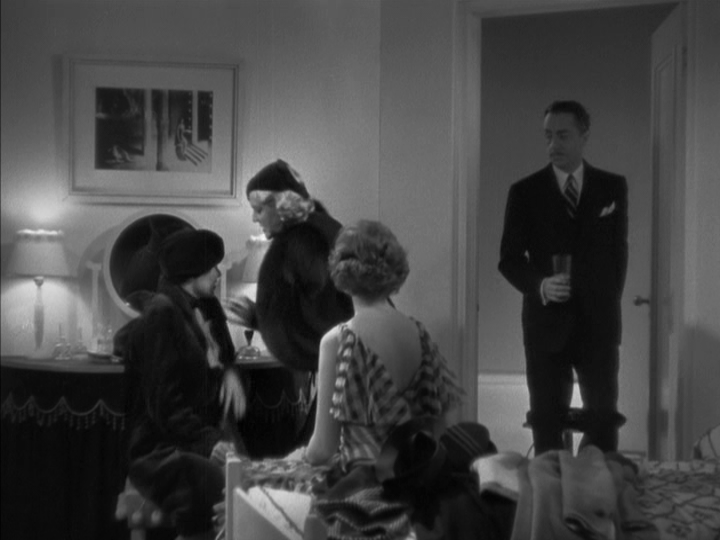
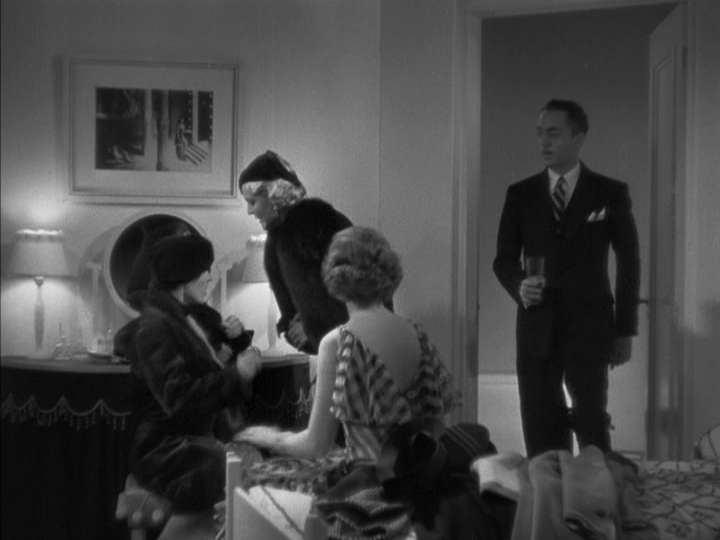
They and Dorothy’s brother Gilbert (William Henry) all descend on a Christmas party that Nick and Nora are hosting in their apartment for an eclectic collection of colorful figures from Nick’s former life. During the festivities a shady figure named Nunheim (Harold Huber) calls in with information related to the case:
As described by Fran Mason in his book Hollywood’s Detectives, the result of all of this is to “disorder Nick’s world, most obviously when Mimi slaps Dorothy in front of Nick and Nora because she believes that Dorothy has revealed information that thwarts her plan to blackmail Wynant on his expected reappearance”:
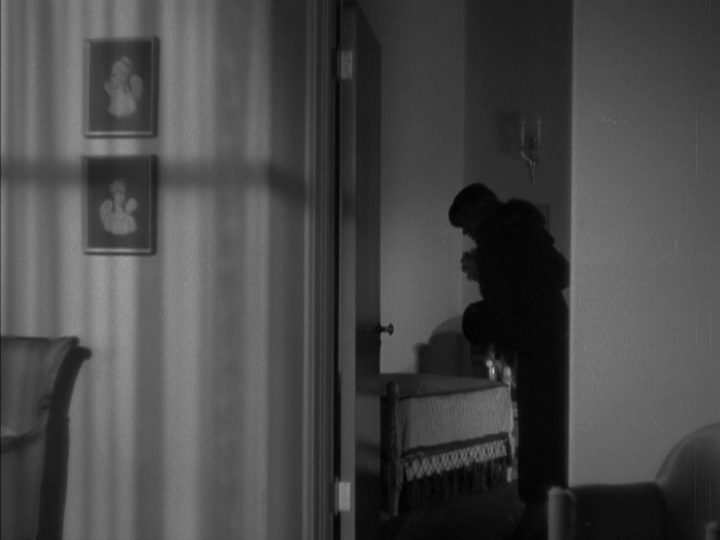
And although it isn’t until after they leave that the party “degenerates into an anarchy of tuneless singing, drunken disagreements and maudlin sentimentality,” Mason argues that “it is implied that they cause the disorder by bringing their world of crime, venal desire and pathologies to the hotel room to disturb the small world of Nick and Nora.” Thus when Nora sighs, “oh Nicky, I love you because you know such lovely people” at the end of the evening:
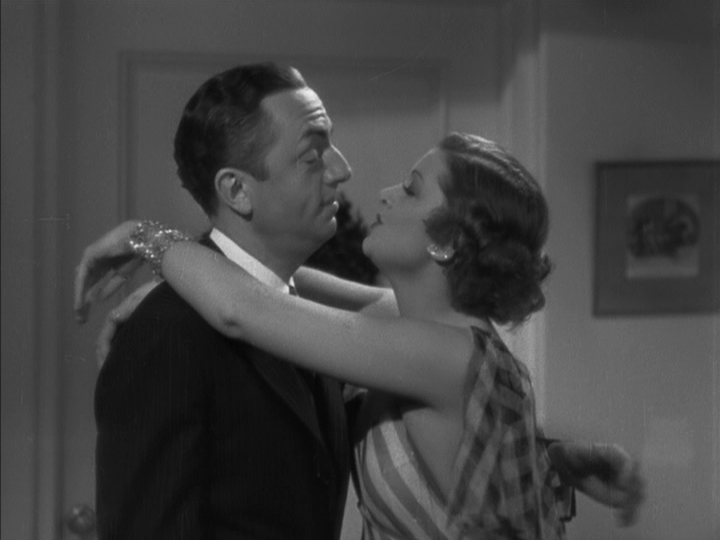
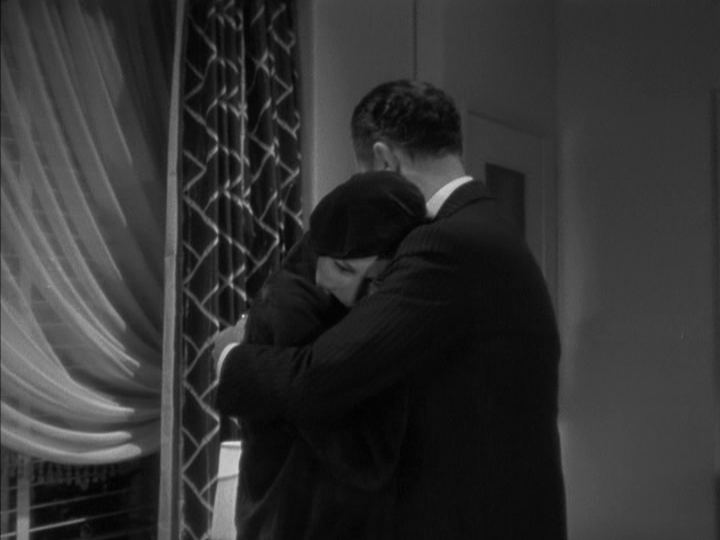
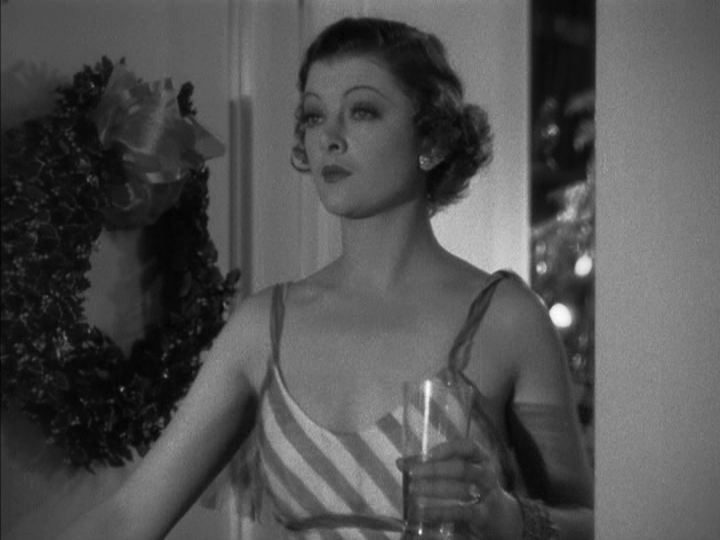
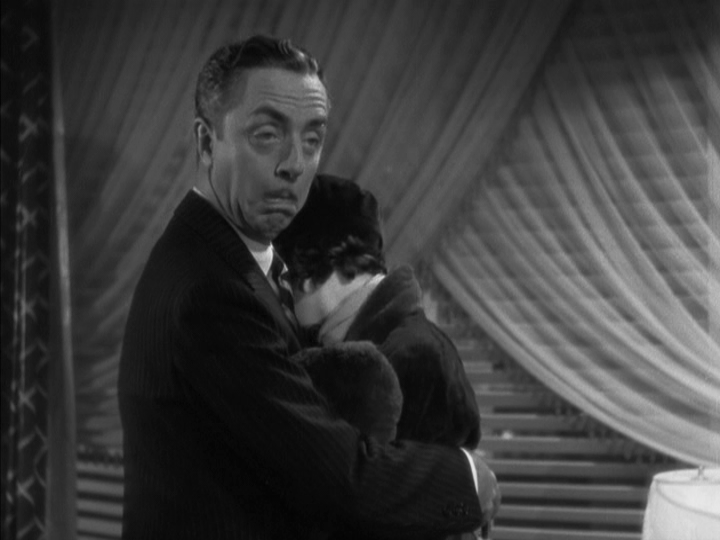
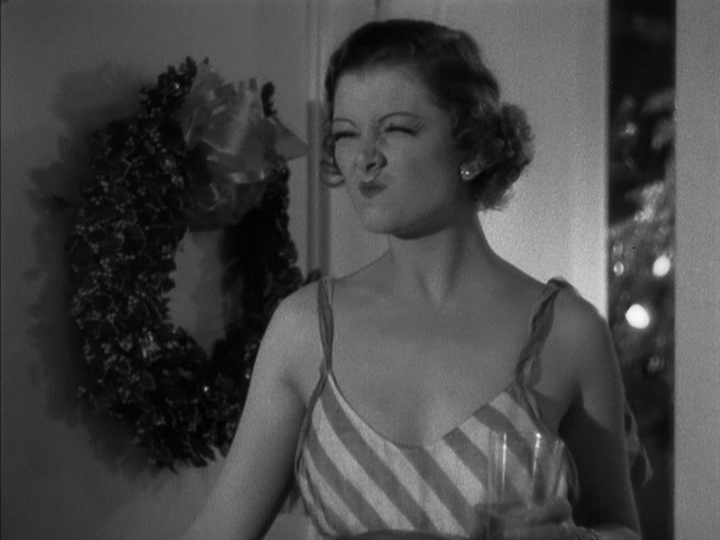
The line “applies as much to the Jorgensens and people like them as it does to the working class and underworld figures from among Nick’s acquaintances who are still present.” This sequence also again showcases the strong bond between the central couple when Nora walks in on Dorothy embracing Nick, which Kozlowski notes director W.S. Van Dyke “stages as if it would become one of those dramatic incident in which a wife sees her husband with another woman in her arms”:
He follows it with two quick pans, though, one to Nick making a face at his wife:
And then one of her crinkling her nose at him in return:
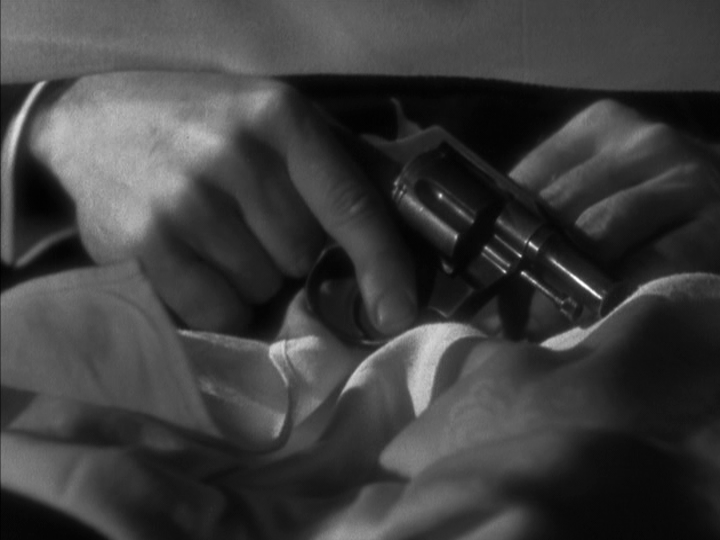
“By panning between the embrace and Nora’s reaction rather than cutting between them,” Kozlowski observes, “again we have Nick and Nora as one unit rather than being edited apart from each other, and we establish again that this married couple trusts each other completely.” That night Nick saves Nora’s life by knocking her out before the man who has broken into their apartment (Edward Brophy) can shoot her:
Now well and truly implicated in the case, Nick proves his mettle by solving it in relatively short order with an assist from Asta, who locates a body in Wynant’s factory when Nick decides to visit it on a hunch:
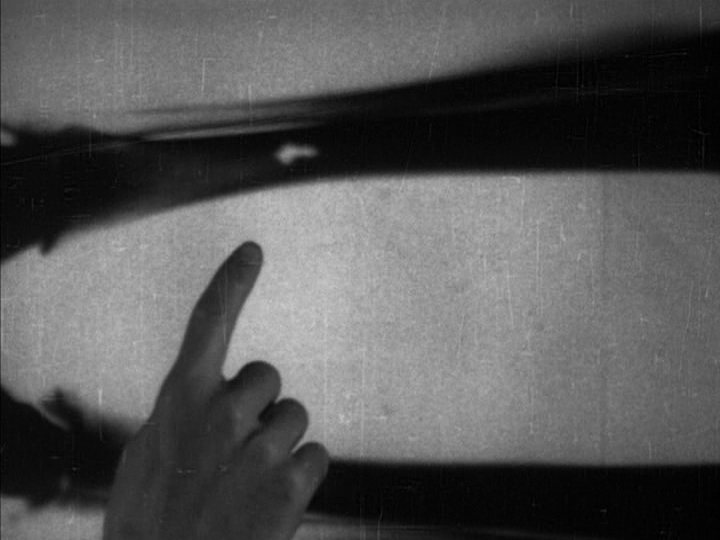
The police fall for the false clues buried with it and conclude that they’ve found someone else who was killed by Wynant, who at this point is their number one suspect, but Nick recognizes a piece of shrapnel visible in fluoroscopy:
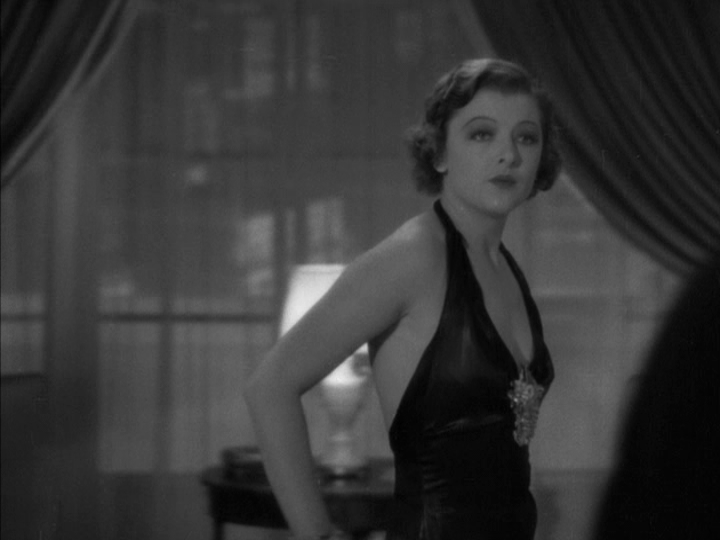
And in classic murder mystery style organizes an elaborate dinner party to reveal who *did* do it, but not before he asks if Nora has a “nice evening gown” to wear to it, which per Nochimson confirms that he shares her “forthright understanding of glamour as armor and costume that the two of them manipulate.”
She does, and it is indeed “a lulu”:
After sadistically torturing nearly every guest by suggesting that they are the guilty party, Nick provokes the real killer into incriminating themself before the main course is even served:
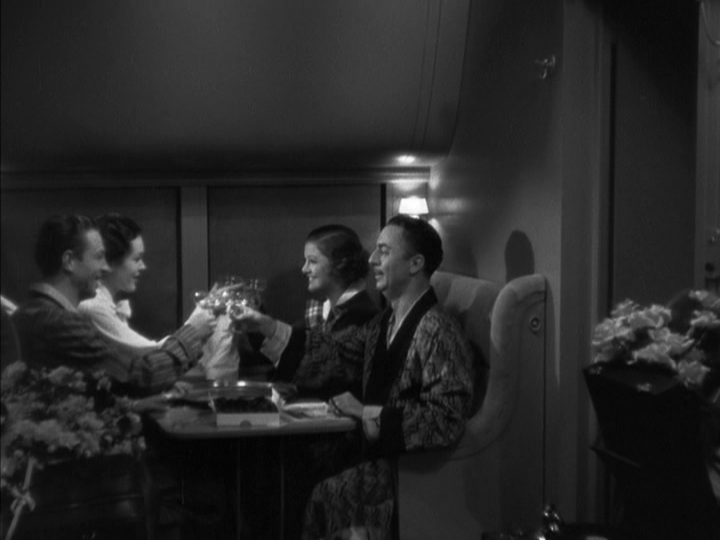
And the movie’s penultimate scene finds Nick and Nora in the sleeping car of a cross-country train toasting their success with Dorothy and her new husband Tommy (Henry Wadsworth) in an off-center composition by cinematographer James Wong Howe that makes it clear the Charles’s have overstayed their welcome by including the door:
Hopefully the honeymooners have been paying attention, because their elders have been giving them and us a master class on the art of a happy marriage. As summarized by Elizabeth Kraft in her book Restoration Stage Comedies and Hollywood Remarriage Films, the central theme is that “it is a supremely adult activity and requires both maturity and common sense, along with the opposite ability, that is, the childlike ability to play and invent and enjoy.” Which come to think of it reminds me of my description of Drink & a Movie #1 The Tamarind Seed as “a thoroughly grown-up film to enjoy with your adult beverage! I’m not sure whether or not there’s an overarching theme there, but it strikes me as a fine place to leave off regardless. As mentioned above I’m planning to turn these posts into a book, which I think will involve a lot of cutting. A graphic designer friend has offered to help me, and I’m optimistic that the end result will make for an attractive and useful Christmas present for family and friends, so with any luck I’ll be done before next New Year’s Eve. I’ll order a few extra and sell them at cost from this site, so stay tuned if you’re interested! In the meantime, my liver has earned a good, long rest for services rendered, and I’m planning to abstain from alcohol for the duration of 2026–after all, even Nick Charles himself eventually confined himself to cider for the entire runtime of The Thin Man Goes Home! This means no cocktail commentary for awhile, but I do intend to keep up my pace of one illustrated longform post about movies per month on average. It isn’t midnight yet, though, so I have time for one last Martini before then. Here’s to you for reading!
Cheers!
All original photographs in this post are by Marion Penning, aka my loving wife.Links to all of the entries in this series can be found here.
What I’m Seeing This Week: My loving wife’s side of the family is in town until Saturday, then we’re off to Virginia to spend second Christmas with mine, but I’m hoping to catch Marty Supreme at the Regal Harrisonburg during our travels or at either Cinemapolis or the Regal Ithaca Mall after we get back. I might try to see Song Sung Blue at one of those theaters as well.
Also in Theaters: I’m still processing The Secret Agent, but it’s definitely my favorite of the new releases now playing Ithaca that I’ve already seen. I also enjoyed Hamnet and Wake Up Dead Men: A Knives Out Mystery. All three of these films continue their runs at Cinemapolis. At this point I’m pretty sure we’re waiting for Now You See Me: Now You Don’t, Wicked: For Good, and Zootopia 2 to become available via streaming video, and while director James Cameron presumably wants you to see Avatar: Fire and Ash on the biggest screen possible, the best thing about it is Oona Chaplin’s performance, so I think it’s safe to wait on that one as well. I am still hoping to see The Housemaid before it closes, though. All five of these films are at the Regal. There understandably isn’t much happening this week on the special events front, but noteworthy repertory options include personal holiday favorites It’s a Wonderful Life, Gremlins, and Daddy’s Home 2 at the Regal today, tomorrow, and Monday respectively.
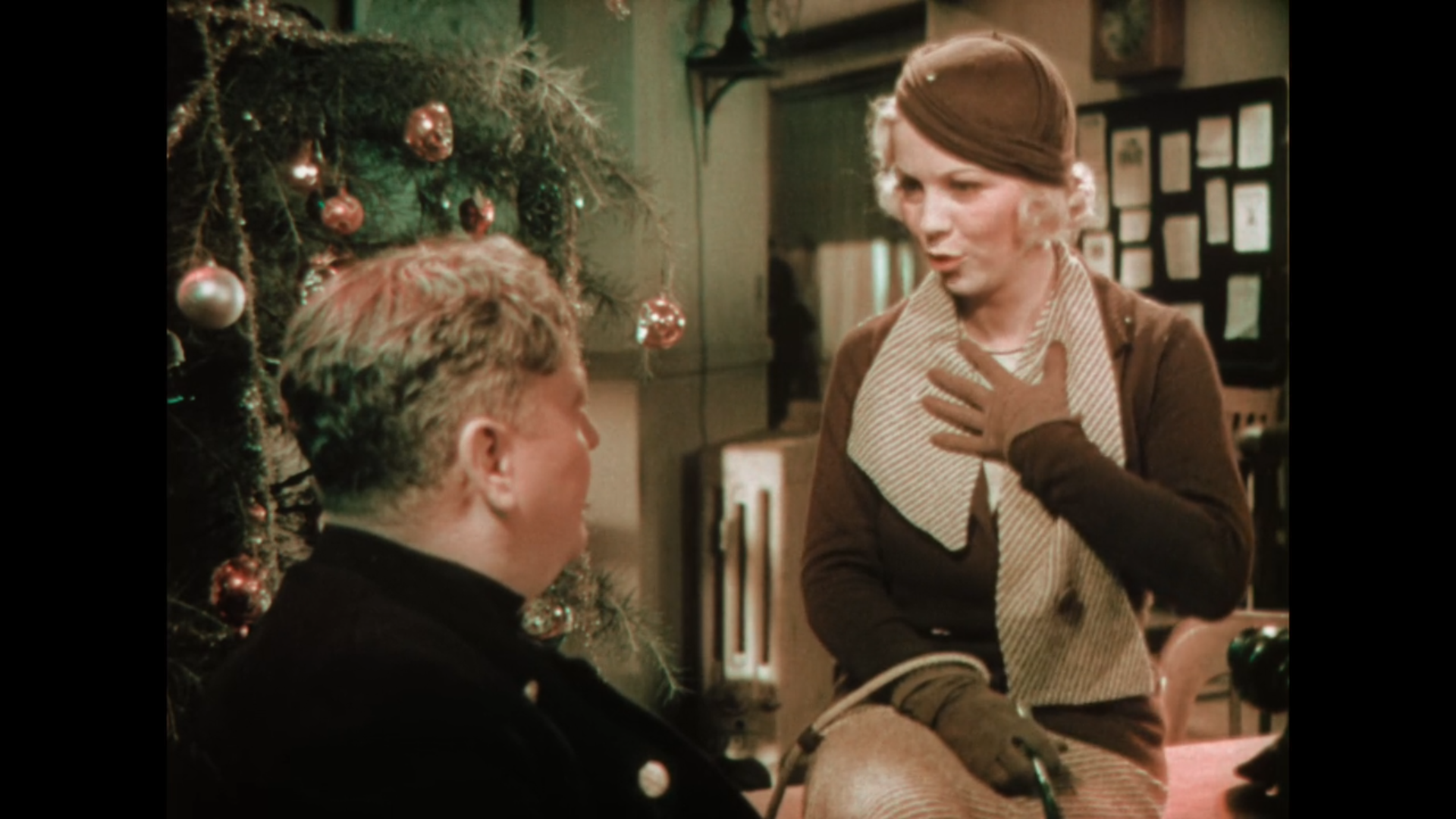
Home Video Recommendation: I was planning to wait until New Year’s Day to talk about Mystery of the Wax Museumbecause that’s when a lot of the main action takes place, but I’m moving it up a week because it it disappears fromHBO Max on Wednesday. There is a green and red Christmas tree that shows off the color separations of two-strip Technicolor:
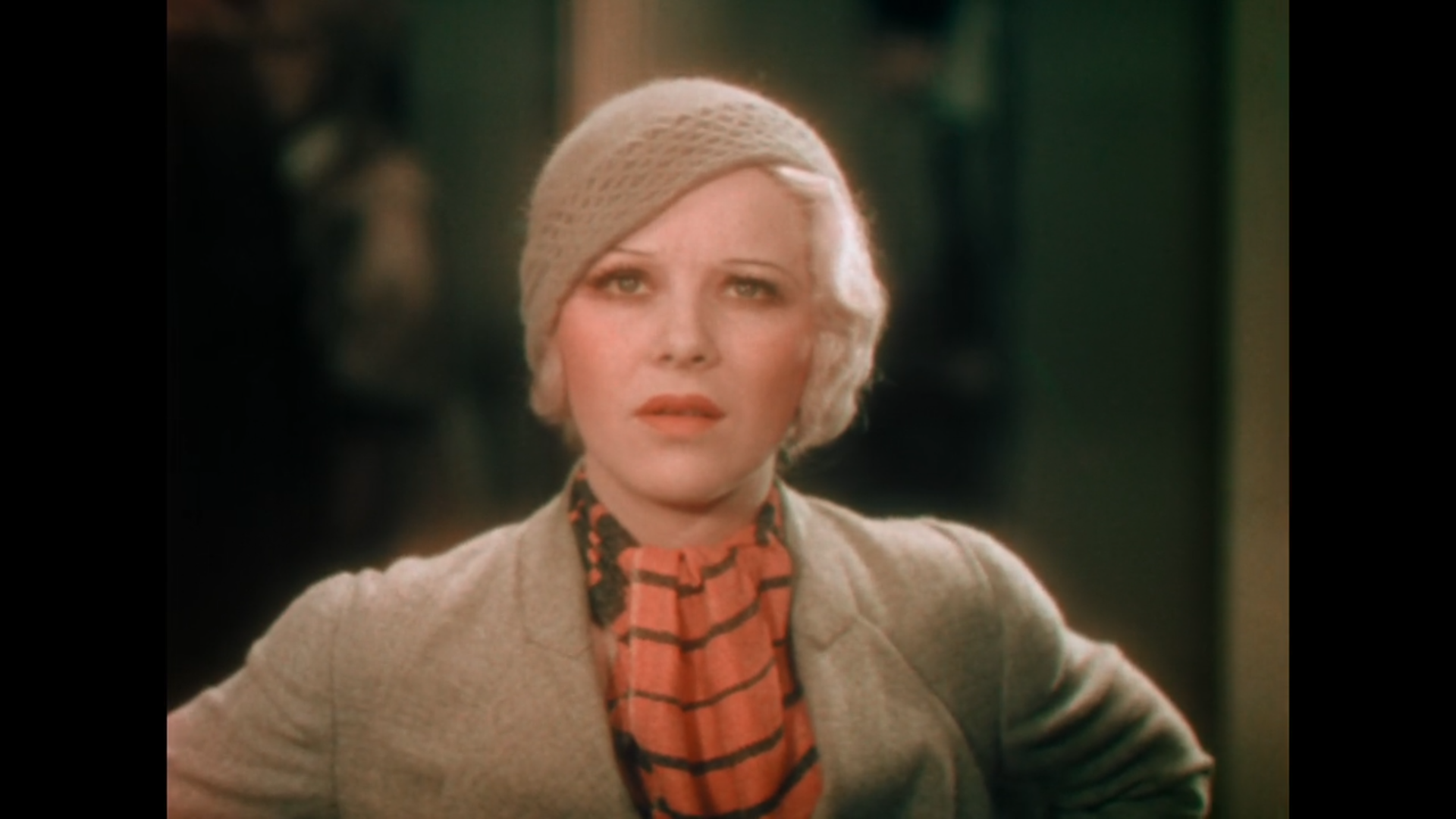
Which are admittedly done greater justice by the wardrobes of Glenda Farrell and Fay Wray:
But while the post-holiday hungover world of this movie is positively drenched in these hues, here they represent envy and embalming fluid, not holly and mistletoe. It’s the ending that really fascinates me, though, as I recently noted on Letterboxd. That review contains spoilers, so I won’t copy-and-paste it into this post, but leave me a comment if you do decide to watch Mystery of the WaxMuseum on my recommendation and let me know what you think!
Previous “Ithaca Film Journal” posts canbe found here.A running list ofall of my “Home Video” recommendations can be found here.
Also in Theaters:Peter Hujar’s Day has one more screening before it closes at Cinemapolis this afternoon and is well worth 76 minutes at your time. I enjoyed Hamnet and Wake Up Dead Man: A Knives Out Mystery, which remain there at least through the end of the week, too. We probably aren’t going to make it to Wicked: For Good(Cinemapolis and the Regal) or Zootopia 2 (Regal) before the end of the year, but they’re on my list as well, and I’m also hearing good things about The Housemaid (Regal). This week’s special events highlight is definitely the free screening of It’s a Wonderful Life at Cinemapolis on Sunday. Finally, on the repertory front, you can catch both my December 2023 and 2024 Drink & a Movie selections National Lampoon’s Christmas Vacation and Elf at the Regal tomorrow and on Wednesday respectively. Those are probably *my* three favorite Christmas movies at all time, but if you’re a Christmas in Connecticut or A Christmas Story partisan, they play the Regal tonight and Saturday respectively as well.
Home Video Recommendation:Highest 2 Lowest currently only ranks 59th on the aggregator website criticstop10.com’s “Best Movies of 2025” list, but I’d put it ahead of all save one (Eephus) of the 33 films ahead of it that I’ve seen so far. Here’s what I said on Letterboxd in August after my first viewing at Cinemapolis:
When I made High and Low a “home video” recommendation on ye olde blog a couple months ago, I mentioned that “I definitely do see the appeal of turning director Akira Kurosawa’s literal and figurative wide-angle lens on today’s America.” This turns out to be one of the notes that director Spike Lee DOESN’T play, though. From his own songbook, a multi-character racist rant is also lacking because after all these years we no longer need anyone to break the fourth wall to know what they’re thinking. Howard Drossin’s lush original score and Matthew Libatique’s camerawork in the scenes it accompanies scream leather-bound books and rich mahogany and create a wonderful contrast with the grittiness of the world outside Denzel Washington’s David King’s penthouse apartment. Looking forward to watching this one again!
I revisited it on Apple TV the other day and am happy to report that it holds up just fine! Of course, between this and Blue Moon, which is likely to also end up on my own top ten list when I publish it in March, I now feel like I need to find 140 minutes to rewatch Oklahoma! before it leaves Watch TCM on January 8. I guess I know what my next Family (née Friday) Movie Night selection will be!
Previous “Ithaca Film Journal” posts canbe found here.A running list ofall of my “Home Video” recommendations can be found here.
What I’m Seeing This Week: I’m going with Peter Hujar’s Day, which is at Cinemapolis for one week only starting tomorrow.
Also in Theaters:One Battle After Another returns to the Regal Ithaca Mall tomorrow and reclaims its title as the best new movie in Ithaca that I’ve already seen. I also enjoyed Hamnet and Sentimental Value, which I won’t begrudge any of their wins this awards season, and Wake Up Dead Man: A Knives Out Mystery, which interestingly uses Daniel Craig’s Benoit Blanc as more of a structuring device than a main character, not dissimilarly to how director Jacques Tati utilized Monsieur Hulot in last December’s “Drink & a Movie” selection Playtime. All three are at Cinemapolis. Other first run fare I’m hoping to catch before it closes includes Wicked: For Good (Cinemapolis and the Regal), Zootopia 2 (just the Regal), and maybe Eternity (Cinemapolis and the Regal). Special events highlights include a screening of the documentary Eyes on Ukraine at Cinemapolis on Sunday followed by a “talkback” with the filmmakers. Finally, noteworthy repertory options include screenings of The Polar Express at the Regal on Saturday and Tuesday and Scrooged there just on Tuesday. The 2000 remake live-action remake of How the Grinch Stole Christmas, which I recently saw for the first time and was surprised to discover actually isn’t half bad, is at the Regal all week as well: as I said on Letterboxd, I think “Bizarro Elf“ is the proper lens to view it through. Speaking of which, there’s a “sing-a-long” screening of Elf (whatever that means) there on Sunday, too.
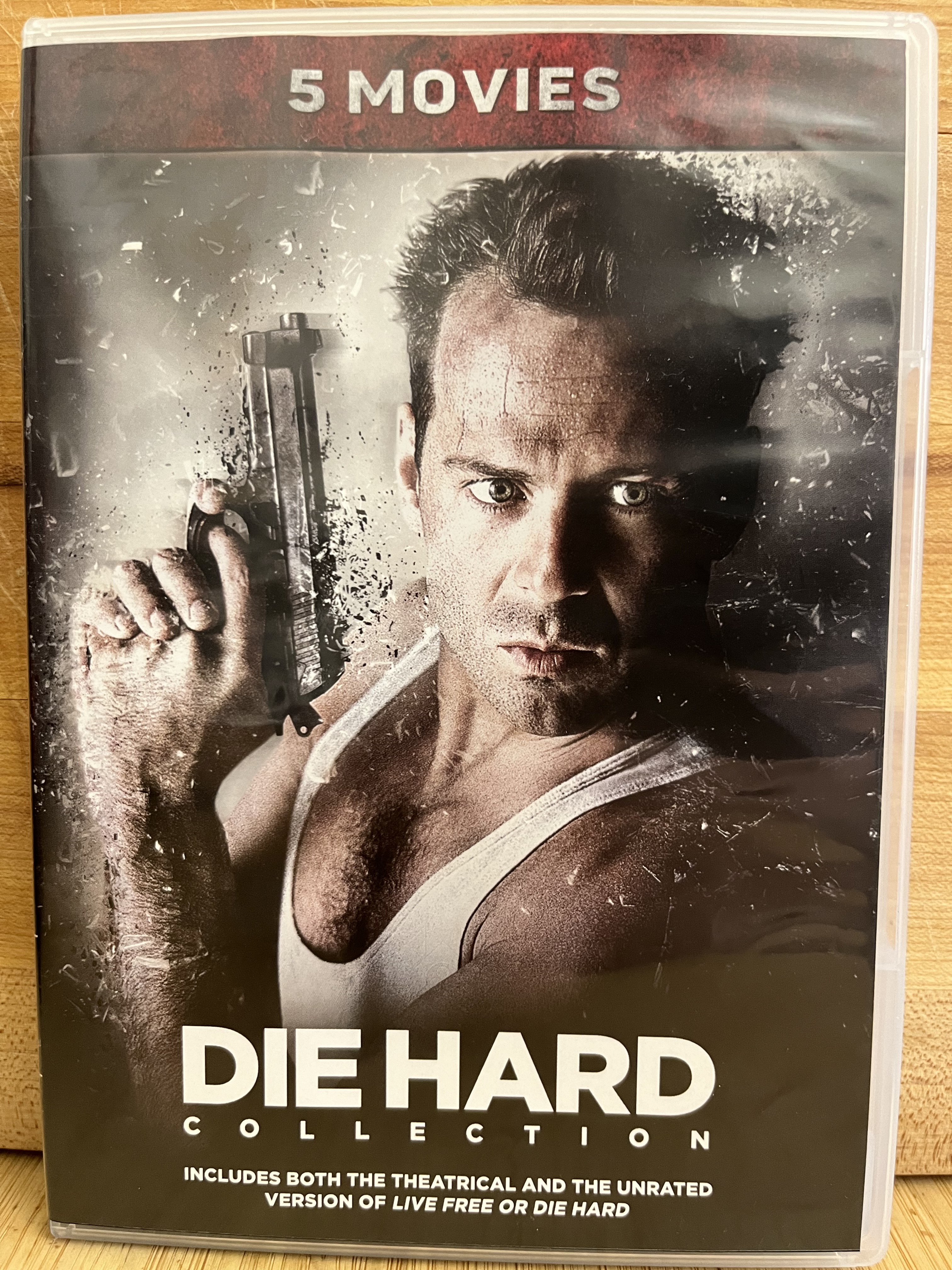
Home Video Recommendation: As was presumably obvious from this month’s “Drink & a Movie” post, I consider Die Hard to be one of the best movies of the 1980s. Its sequel Die Hard 2 is nowhere near as formally intricate but it is not at all without its charms, including a scene featuring William Sadler doing Tai Chi stark naked, and some spectacular special effects. But the final word on the merits of this film were already written by Kenji Fujishima, who in a 2009 blog post that I absolutely love said the following:
Many argue that Die Hard 2, on the other hand, is a crasser, cruder rehash of the original, emphasizing the action spectacle while downplaying character development, and upping the ante on violence and gore. All of that is indeed true. And yet, in the right mood, I find that Die Hard 2, in its own caveman way, provides more sheer pedal-to-the-metal excitement than the relatively sober-suited original. In fact, I would go so far as to put forth this notion: Die Hard 2 is the Indiana Jones and the Temple of Doomof the Die Hard series.
Do please read the whole thing to find out why, then go watch Die Hard 2 on Disney+ or Hulu!
Previous “Ithaca Film Journal” posts canbe found here.A running list ofall of my “Home Video” recommendations can be found here.
What I’m Seeing This Week: The snow on Tuesday waylaid my plans, so catching a screening of Wake Up Dead Man: A Knives Out Mystery at Cinemapolis is still my number one priority. I’m excited to finally see Hamnet there as well!
Home Video Recommendation:The Teachers’ Lounge was recently featured in the New York Times’s “Watching” newsletter, which reminded me that I somehow never got around to revisiting it despite the fact that it has been available on Netflix with a subscription for ages! Here’s what I said on Letterboxd back in February, 2024:
Features some of the Movie Year’s most excitingly thought-provoking final shots. Oskar (Leonard Stettnisch) solves the Rubik’s cube that Carla Nowak (Leonie Benesch) lent him earlier, confirming that like her he speaks the language of logic and mathematics. Which: compare her loyalty to him to her earlier refusal to speak Polish with her colleague Milosz Dudek (Rafael Stachowiak). Anyway, we then survey the empty rooms of the school where the drama has taken place before ending on a shot of Oskar being carried away by the police. The latter establishes the two characters as being united in their respective failures to unlock the escape room they have found themselves trapped in, but then the end credits roll to the strains of Mendelssohn’s overture to A Midsummer Night’s Dream, underscoring the sense of enchantment and theatricality pervasive throughout the entire film (most palpably in the protest or hallucination of the whole school wearing Eva Löbau’s Friederike Kuhn’s distinctive blouse). I’ll need at least one more viewing to figure out what exactly, but there’s definitely a lot going on here and I dig it!
After a second viewing I think what the Mendelssohn overture, which George Grove once wrote “stamps the fairy character of the work” from its opening four chords, brings to the party is the sense that “the world is turned upside down” as John McTiernan put it when writing about the influence of the Shakespeare play it was composed for on this month’s “Drink & a Movie” selection Die Hard. If anything I underrated this film by only ranking it seventh on my “Top Ten Movies of 2023” list, so do check it out!
Previous “Ithaca Film Journal” posts canbe found here.A running list ofall of my “Home Video” recommendations can be found here.
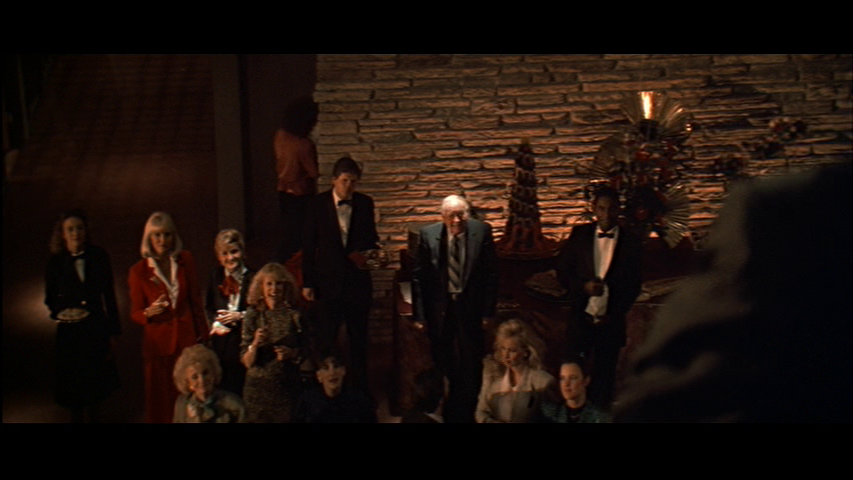
Fear not: this is not yet another polemic weirdly way too invested in convincing you that Die Hard is a Christmas movie! It *is* part of our household’s regular holiday rotation, though, so I’ve been saving a December slot for it and the Chain Smoker from Sother Teague’s I’m Just Here for the Drinks. The pairing is, of course, inspired by Bruce Willis’s John McClane, who quaintly lights a cigarette immediately after disembarking at Los Angeles International Airport approximately two minutes into the film:
Then proceeds to consume at least a full pack before the end credits roll. Here’s how you make it:
Stir all ingredients with ice and chain into a chilled rocks glass. Garnish with a flamed orange twist.
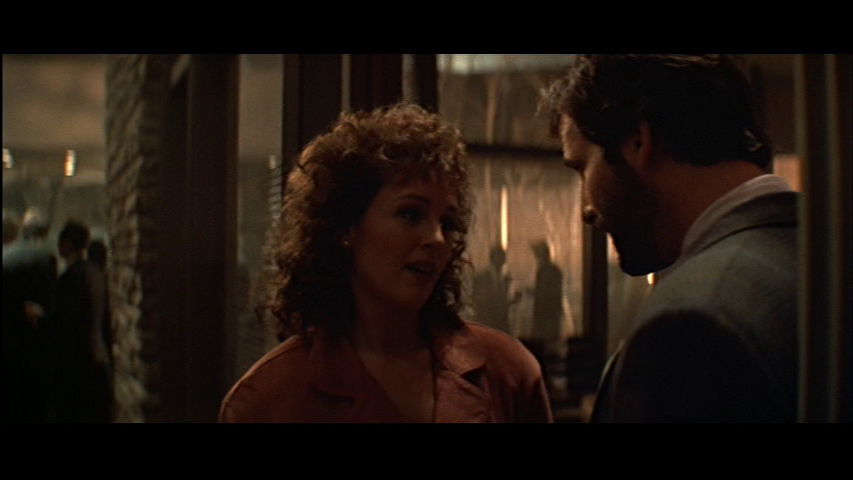
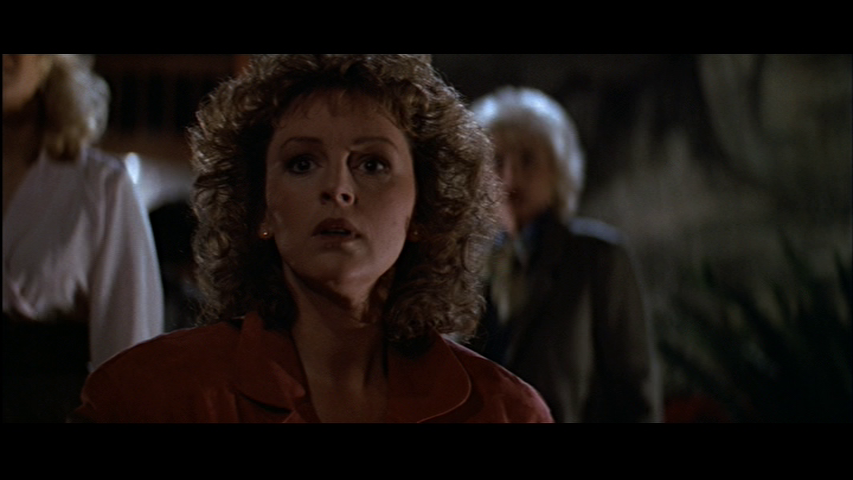
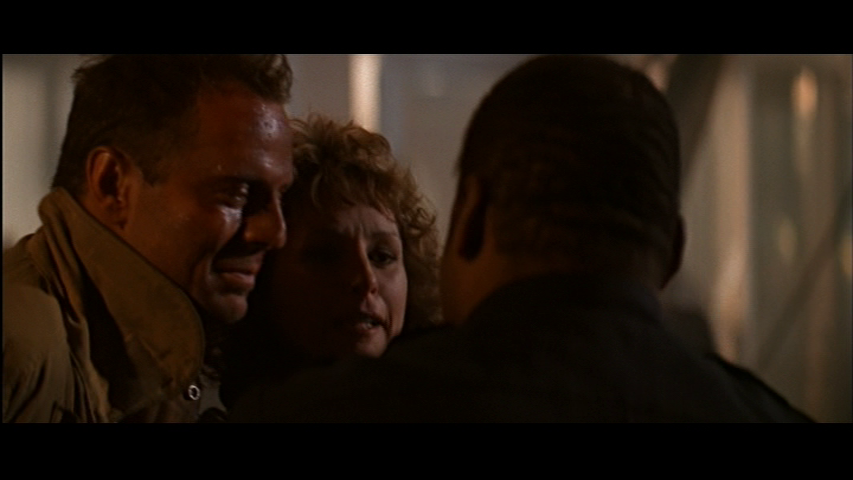
Teague describes the Chain Smoker as “basically a smoky mezcal Manhattan augmented with Zucca, an Italian aperitif, which has a natural smoky flavor from the dried Chinese rhubarb that serves as its base ingredient.” He notes that “the bitters add a subtle citrus note as well as another layer of smoke,” which is what dominates the nose. Flamed twists have always struck me as being more about theater than flavor or aroma, but both Teague and Frederic Yarm swear the burnt oils are a factor here as well. Regardless, agave and grape on the sip give way to a dry finish with roaring fireplace vibes, suggesting that Hart Bochner’s Harry Ellis could serve it with the “nice aged brie” he mentions while clumsily hitting on McClane’s wife Holly (Bonnie Bedelia):
The image above and those which follow all come from my Sony Pictures Home Entertainment Die Hard Collection DVD set:
It’s also available on Hulu and Prime Video with a subscription.
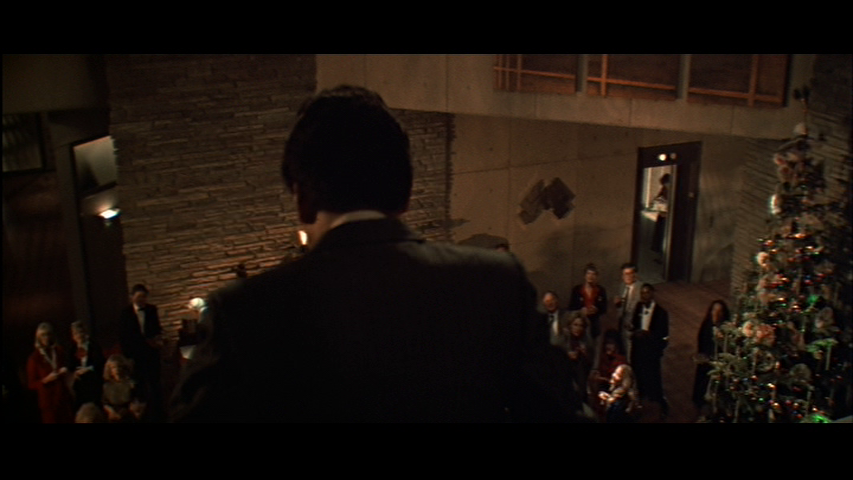
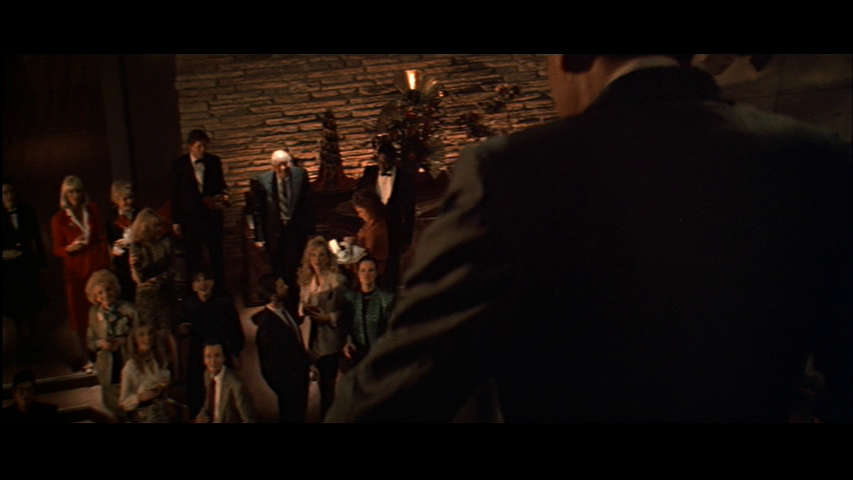
The late, great David Bordwell suggested in 2019 that Die Hard “changed ideas of just how well-wrought an action picture could be.” One way it did this was through the “ingenious ways” it finds to “let the audience’s eye go with you” in its widescreen format, which begins with the scene that immediately follows the image that begins this blog post: Holly’s boss Joseph Yoshinobu Takagi (James Shigeta), president of Nakatomi Trading, addresses the company holiday party, but with his back to the camera because we’re meant to follow Holly as she wends her way through the crowd from the elevator (in its first of many appearances) at the right side of the frame at the start of the shot:
To the hallway at the left, which is where Ellis ambushes her with his offer of old cheese and flames:
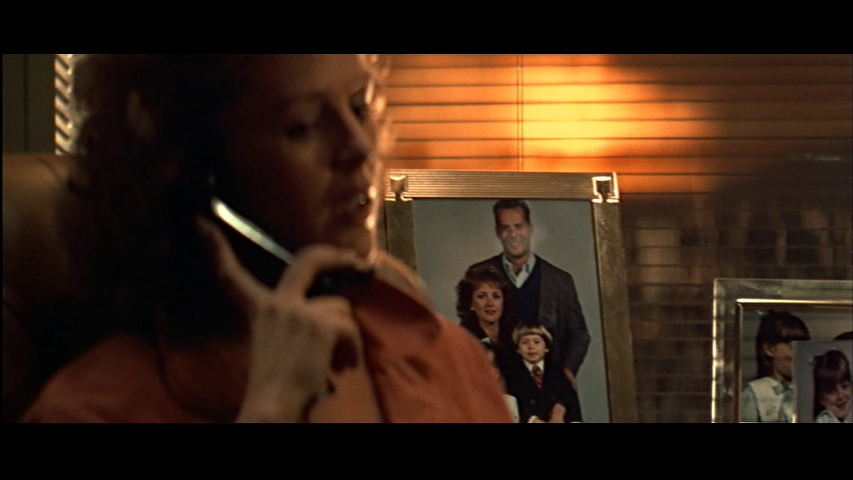
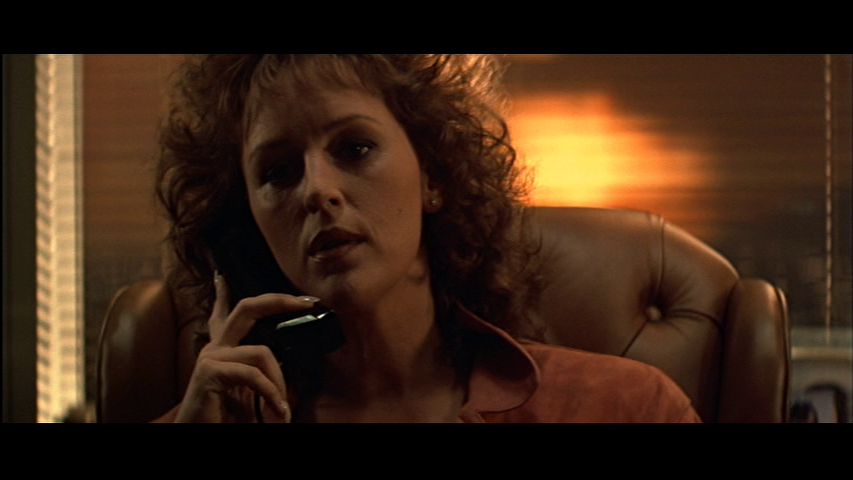
Bordwell also lauds Die Hard as “one of the great rack-focus movies,” and that technique makes an early appearance as well during a telephone call when Holly’s daughter Lucy (Taylor Fry) asks, “is Daddy coming home with you?”
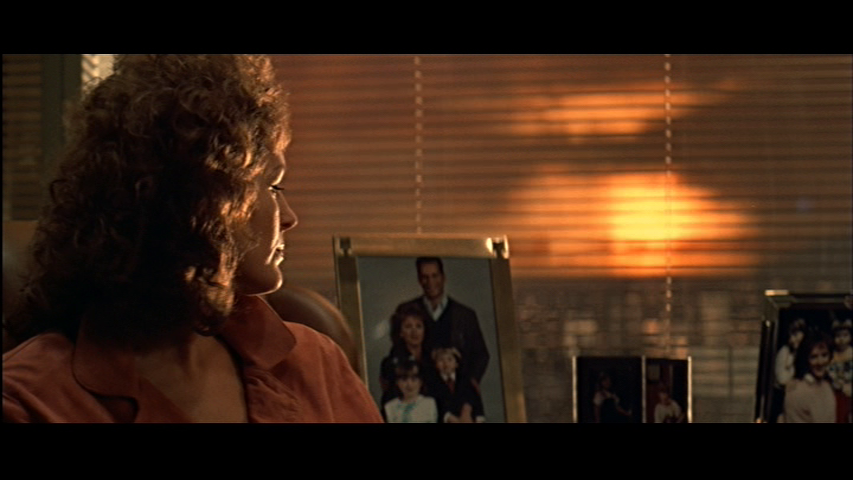
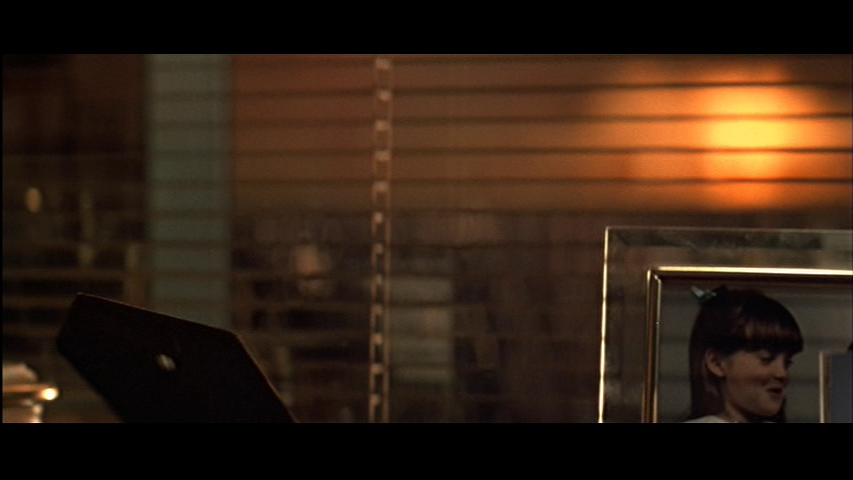
“We’ll see what Santa and Mommy can do,” Holly replies. The maneuver is reversed after she hangs up:
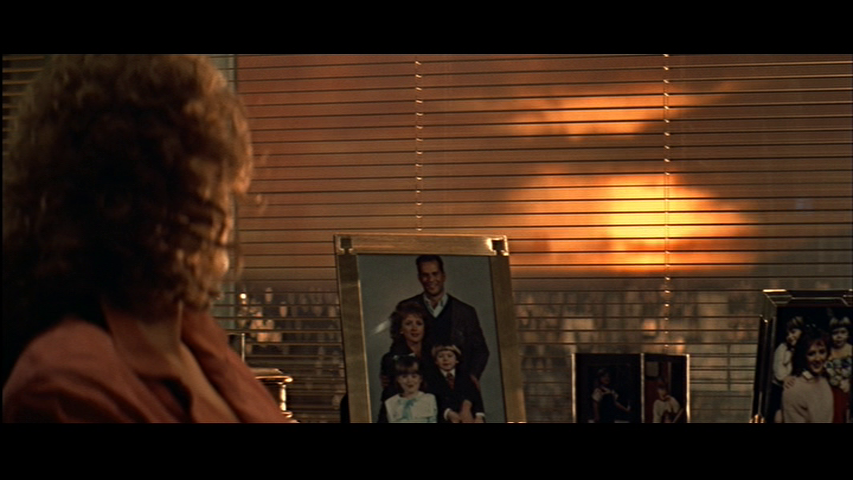
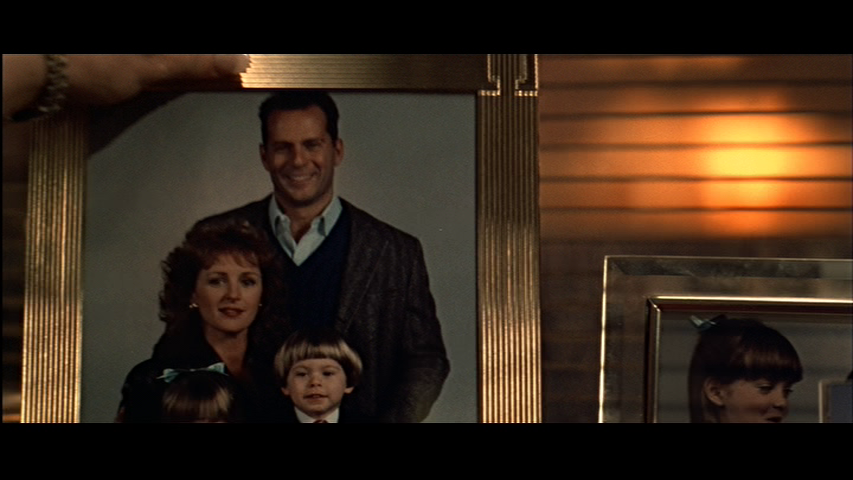
And followed by a cut to a close-up of a family portrait upon which Holly takes out her frustration with her husband, who hasn’t communicated his travel plans to her, by slamming it down:
The photo will reappear nearly exactly one hour later, making it perhaps the most prominent example of what Bordwell calls “felicities” which mark Die Hard as a “hyperclassical film” that “spills out all these links and echoes in a fever of virtuosity.” But I’m getting ahead of myself! First McClane rides in a limo for the first time and is introduced to the holiday classic “Christmas in Hollis” by his driver Argyle (De’voreaux White), who being new to the job also doesn’t realize that it’s customary for passengers to sit in the back:
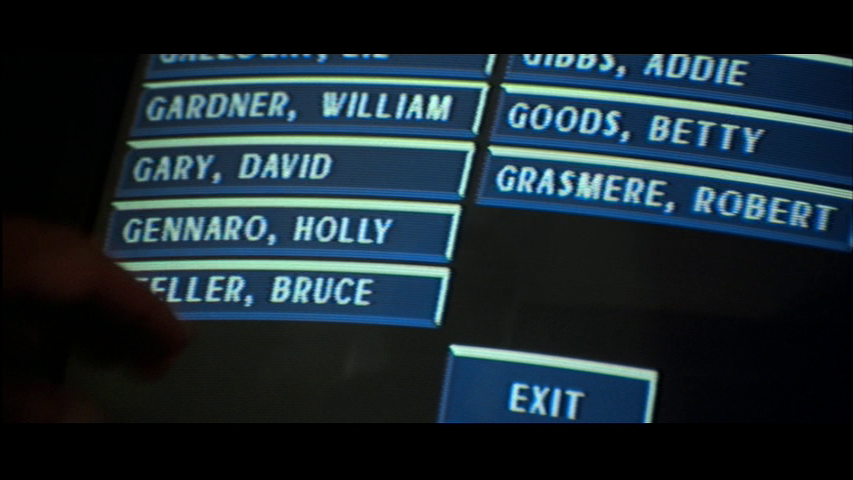
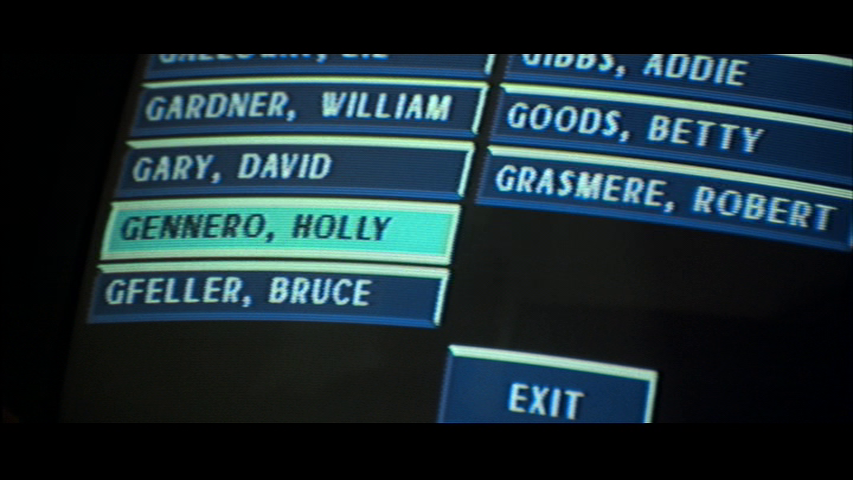
Upon arrival at Nakatomi Plaza he discovers that Holly has started going by her maiden name again when he looks her up on a computer system that may be so advanced that “if you have to take a leak, it will help you find your zipper,” but isn’t much of a consistent speller:
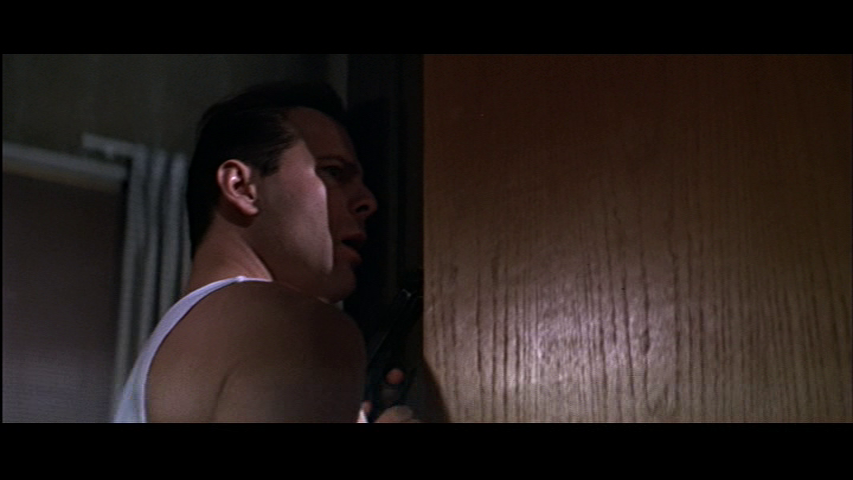
And is in Holly’s office “making fists with his toes” with his shoes off to dispel his jetlag per the advice of the “Babbit [sic] clone” (per the screenplay) he’s sitting next to in the film’s opening scenes when suddenly gunshots ring out. Grabbing his sidearm and rushing to the door, McClane ascertains that a hostage situation is underway:
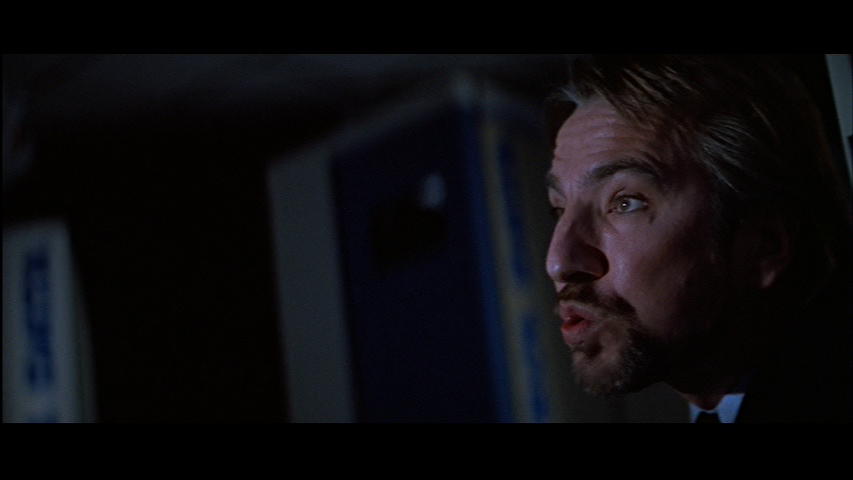
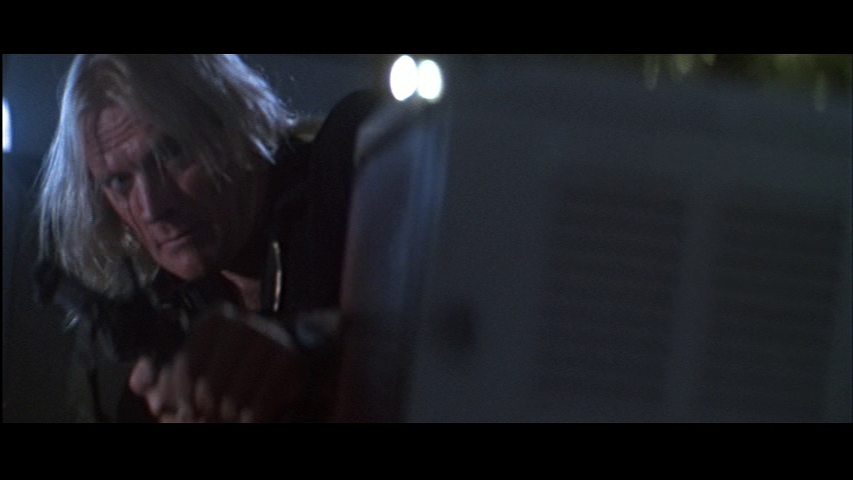
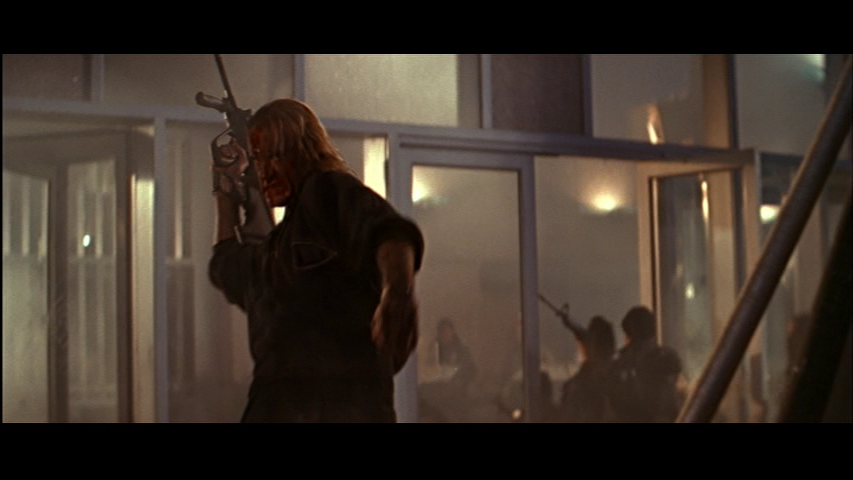
Then takes advantage of the distraction afforded by a topless partygoer to escape into what according to James Mottram and David S. Cohen’s Die Hard: The Ultimate Visual History production designer Jackson De Govia saw as the “steel jungle” of the not-yet-complete Nakatomi building’s stairwells, thus setting in motion what he calls “a survival drama in the context of architecture that’s under construction.” As criminal mastermind Hans Gruber (Alan Rickman) carefully lays his plans, which include wiring the roof with plastic explosives so that he and the members of his team (all of whom, as Nick Guzan details in a terrific blog post ranking their wardrobes, “have distinctive roles, attitudes, and aesthetics”) can eventually fake their own deaths:
And convincing the FBI that he’s a terrorist by way of manipulating them into cutting the power to the building and automatically releasing the last, otherwise unbreakable, lock guarding the company’s vault:
McClane adapts to his new environment. He uses an elevator as a duck blind to scout his foes without being seen:
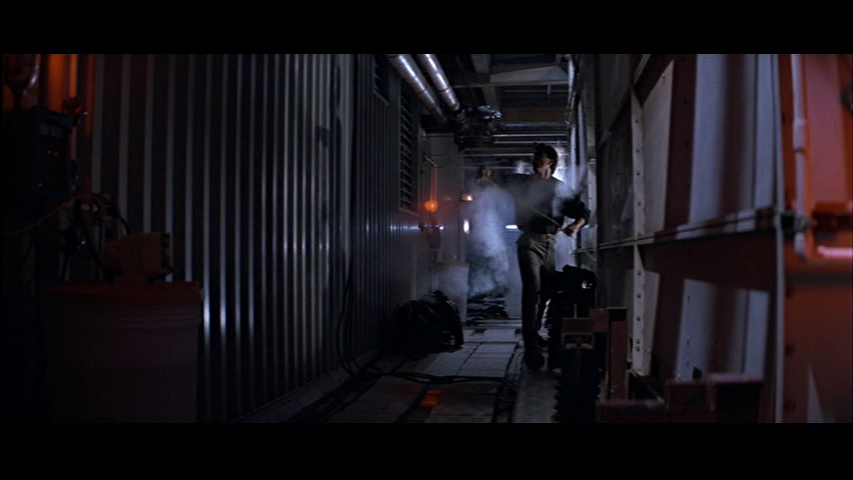
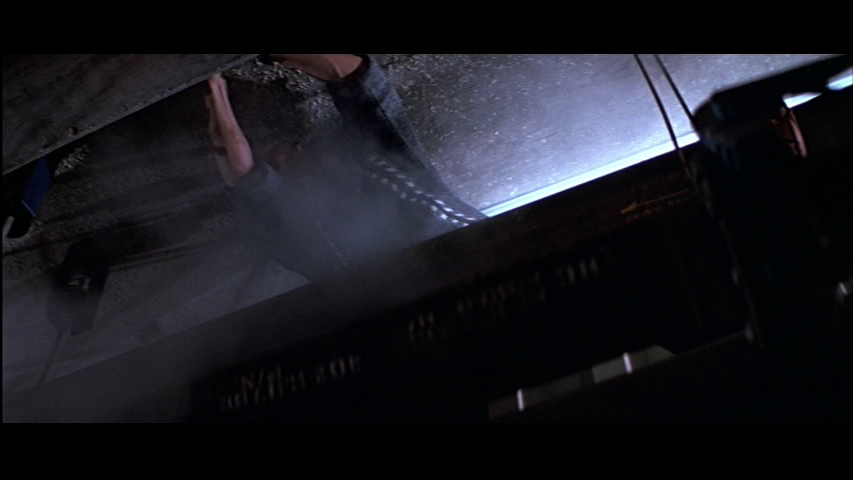
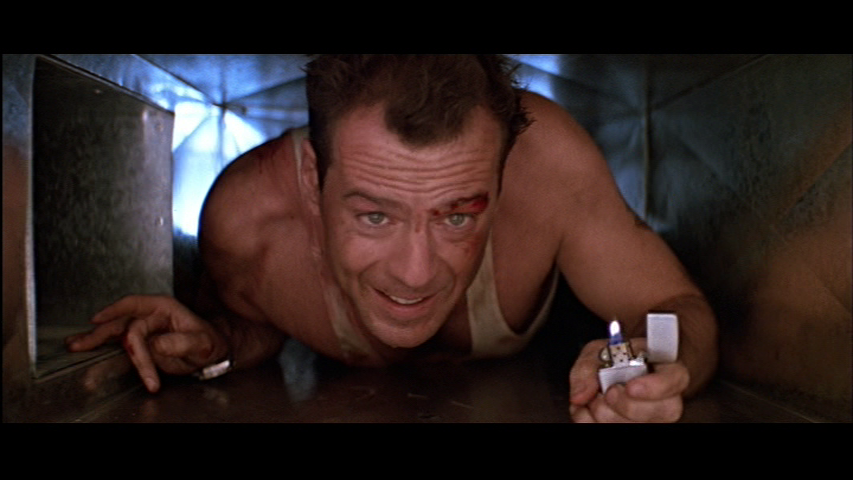
Hides in the cave-like vents that inspired this month’s drink photo:
Sets traps:
And successfully navigates a shootout through a conference table that De Govia chose for the way it “moves like a river”:
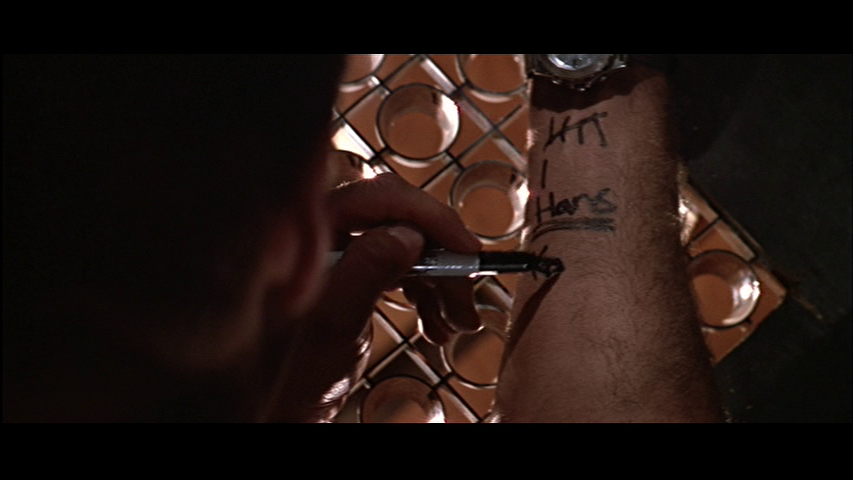
That altercation ends with McClane taking a bag of explosives off the body of one of his fallen adversaries while he identifies himself to Gruber over a walkie-talkie as “just the fly in the ointment, Hans, the monkey in the wrench.”
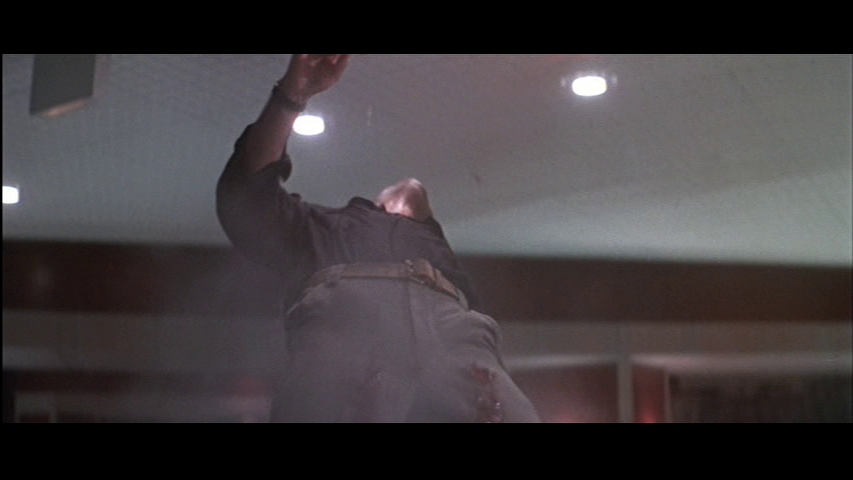
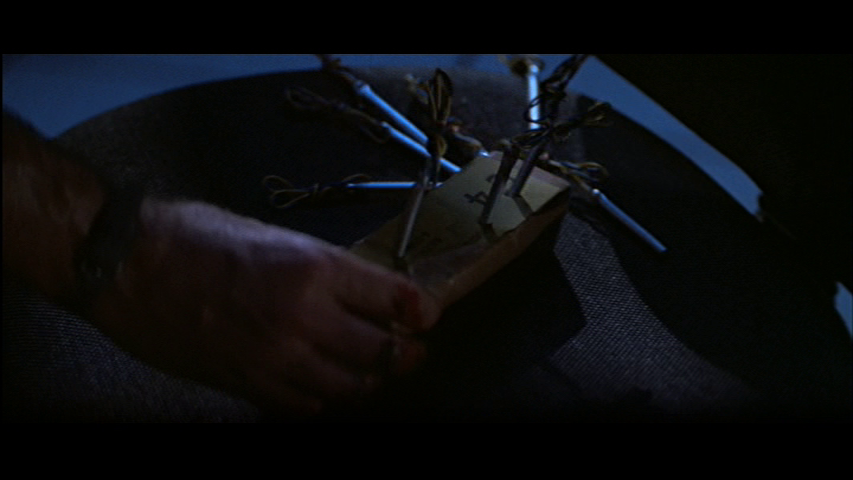
From this point forward they oppose each other more directly. First McClane retaliates against Gruber for firing a second anti-tank at an already disabled police vehicle just to make a point by strapping a bomb to a chair and dropping it down an elevator shaft, taking out two of Gruber’s men:
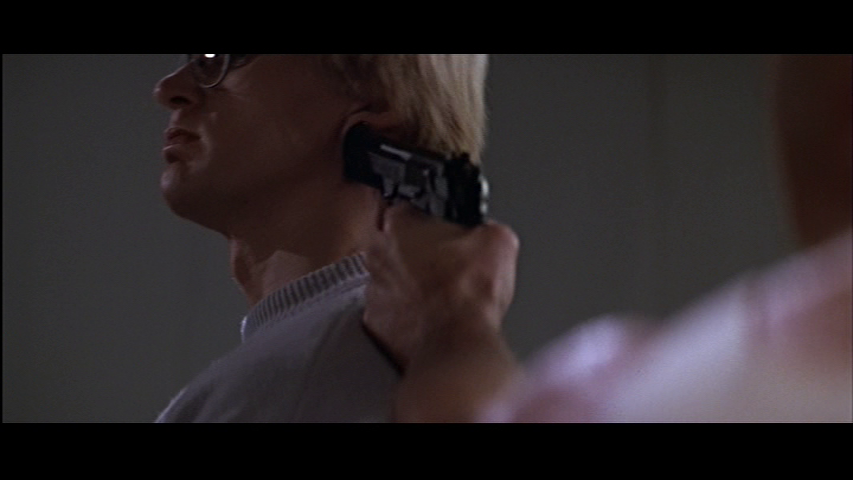
Then Gruber shoots Ellis, who not understanding what he’s up against, foolishly tries to convince McClane to turn himself in:
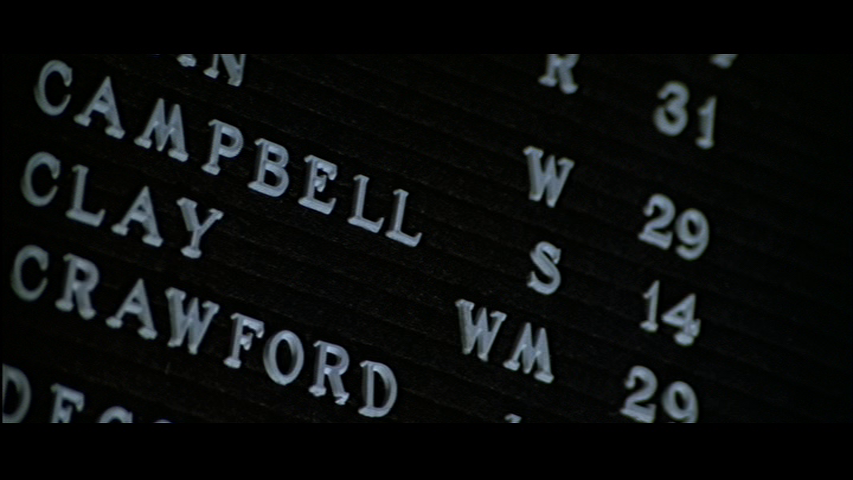
McClane meets Gruber face to face in a scene replete with unsettling canted angles when the latter goes to check on the explosives on the roof, but initially fails to recognize him when Gruber cleverly clocks a floor directory and pretends to be a hostage named Bill Clay:
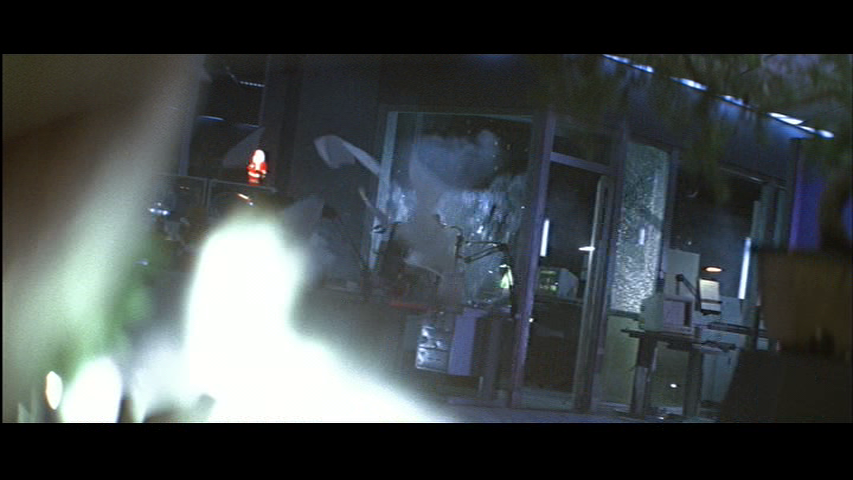
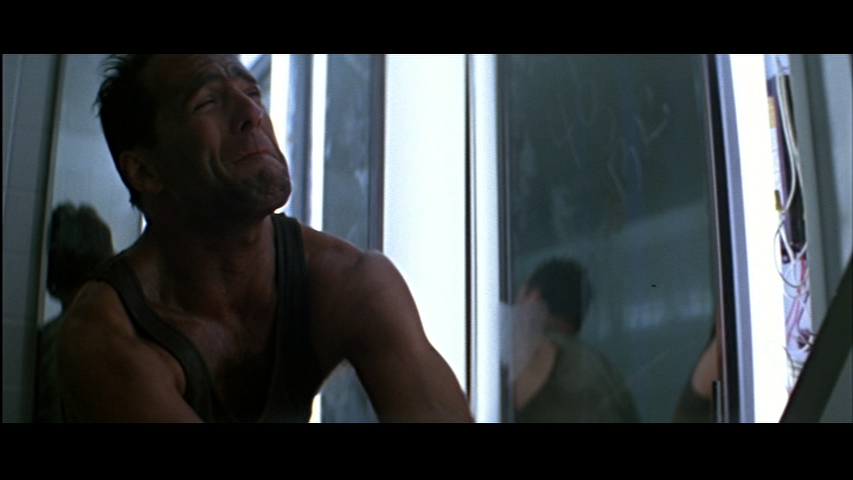
Gruber also notices that McClane is shoeless and is able to hobble him by summoning his henchman Karl (Alexander Godunov) and ordering him to “shoot the glass”:
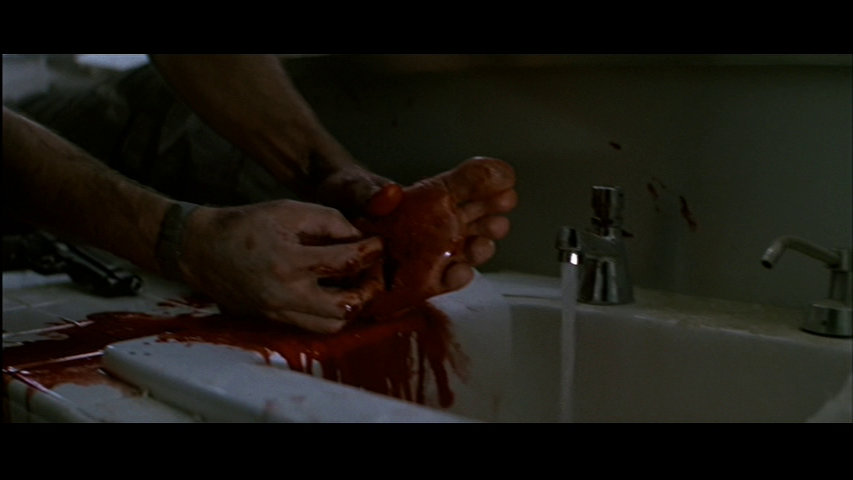
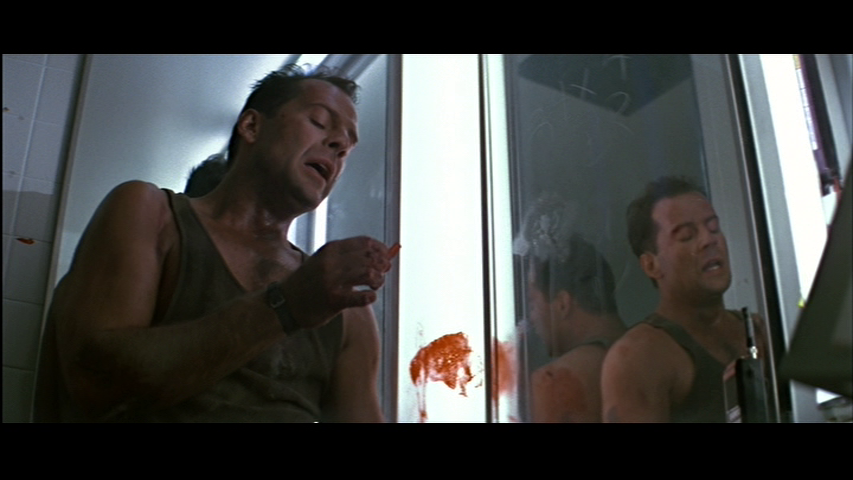
While McClane tends to some of the most painful-looking wounds in cinema history:
Gruber takes advantage of his absence to achieve his goal of gaining access to the $640 million worth of bearer bonds in Nakatomi Trading’s vault in a scene that Robynn J. Stilwell argues in a 1997 Music & Letters article “clearly constructs [him] as a sympathetic, heroic figure as aural and visual cinematic cues and narrative drive come together,” including the “rhythmic speech” of hacker Theo (Clarence Gilyard Jr.) building with the music toward a full-throated statement of Gruber’s Beethoven-based theme, a shot from a “low, powerful angle” of him rising “slowly, awestruck, to his feet, a little breeze ruffling his hair in the halo of the brilliant emergency light”:
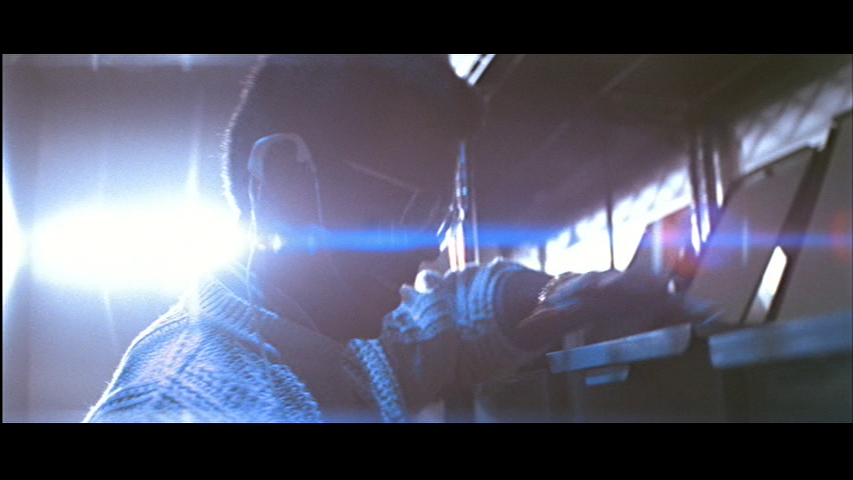
Theo whispering “Merry Christmas” in another striking low-angle composition which dramatically sets him and his white sweater off against the pitch black of the rest of the frame:
And a euphoric tour of the vault’s contents that follows a shot of FBI agents Johnson (Robert Davi) and Johnson (Grand L. Bush) foolishly gloating that “those bastards are probably pissing their pants right now”:
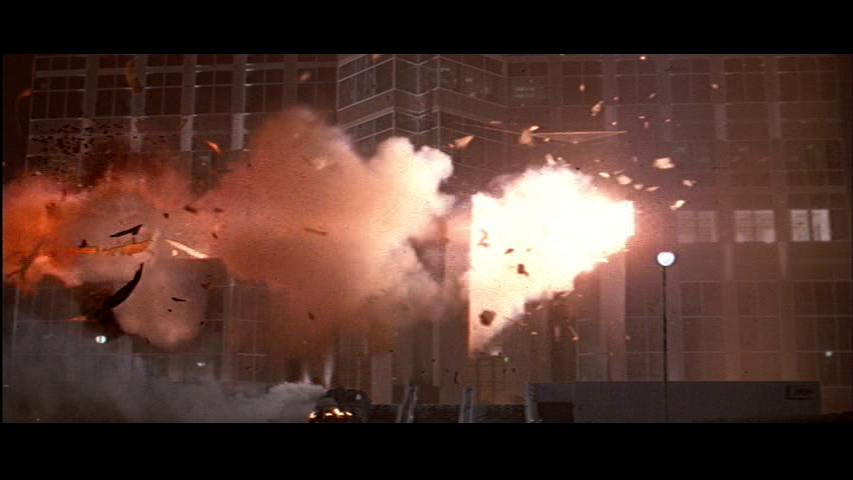
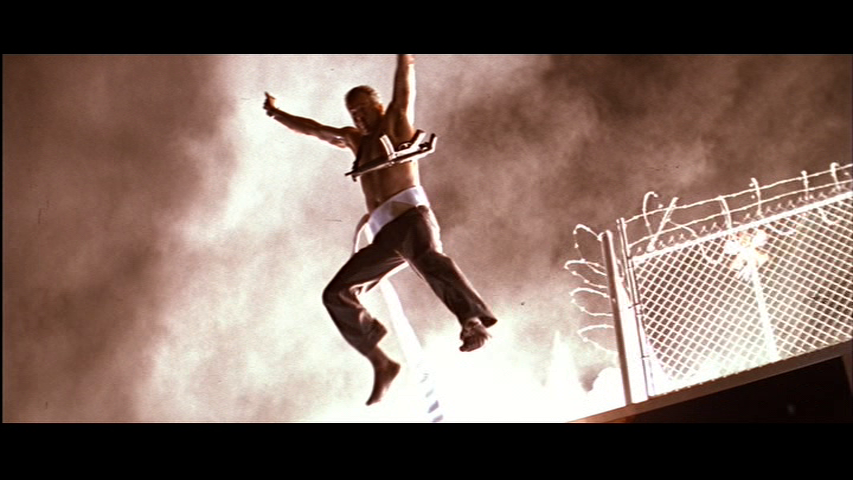
Which makes sense when you remember that, as screenwriter Steven E. De Souza told Dan Frazier in an interview, “if you’re doing genre, the protagonist is the villain.” But while we may be “given every possible opportunity to read Hans as the hero of a caper film,” as Stilwell puts it, “classic Hollywood closure […] demands two things: that Hans die, and that Holly and John McClane are reconciled.” And so Die Hard doesn’t end here. Instead, McClane puts all the pieces together and heads back upstairs, where he battles Karl to the death, saves the hostages from being blown to smithereens, and leaps off the roof of Nakatomi Plaza:
Meanwhile, Gruber solves a puzzle himself when he discovers the picture we talked about earlier and finally figures out how a New York City cop came to be in position to interfere with his California heist:
“Mrs. McClane, how nice to make your acquaintance,” he says, setting the stage for a final showdown.
In his introduction to Mottram and Cohen’s book, director John McTiernan reveals that the inspiration for Die Hard came from a surprising source:
In this case, it was easy. It was right in Shakespeare. He wrote a bunch of plays he called comedies. They weren’t funny ha-ha the way we mean it. They were fun. Basically, fun adventures. And I was pretty sure that one of them fit.
It was about a festival night on which something crazy happens–and for everybody involved, the world is turned upside down. The princes become asses, and the asses become princes, and in the morning the world is put back right and the lovers are reunited.
Now the plot of A Midsummer Night’s Dream is way more complicated than that, but don’t look at that. Look at the totality. It was right there: Tell the story not of the cop and the terrorists but of the people who are part of the event. Let the audience sit back and watch the craziness as a whole. Let them enjoy it.
To Matt Zoller Seitz, writing on the occasion of the film’s 25th anniversary, this sense of fun is what makes the Die Hard great. Citing this shot of a S.W.A.T. team member pricking himself on a thorn as a particularly memorable example:
Zoller Seitz notes that “there’s a strain of satire coursing through the picture” and that “more often than not, what’s being made fun of is machismo itself.” He observes that “McClane is mostly spared this sort of scrutiny, but not always,” which to me is crucial to understanding its ending. First, there’s the specific manner of Gruber’s demise: he plumets to his death only after McClane unclasps a Rolex watch that Holly was given by her employer, which Roderick Heath describes as “a symbolic wedding ring to the new age of rootless money-worship” in a turn of phrase that reminds me of last month’s Drink & a Movie selection.
Afterward McClane spots the beat cop Sergeant Al Powell (Reginald VelJohnson) who supported him throughout his ordeal across a crowded courtyard:
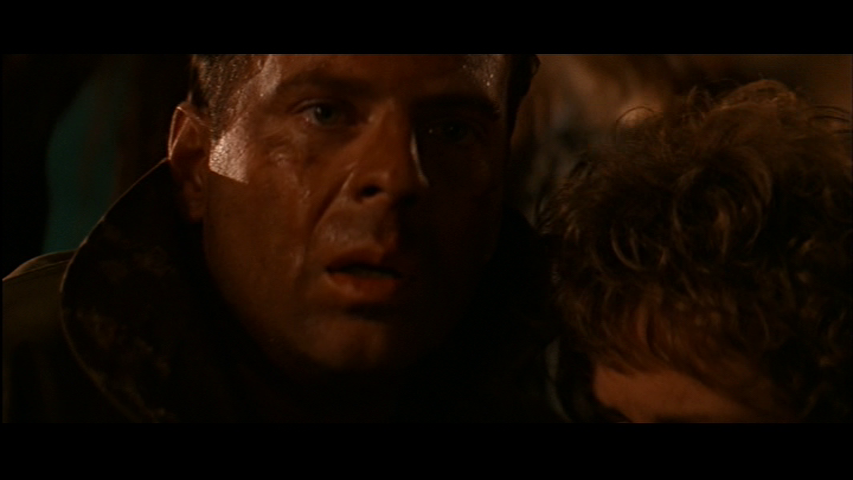
He introduces Holly as “my wife Holly . . . Holly Gennaro,” but she corrects him with a line that understandably rubs a lot of people the wrong way: “Holly McClane“:
In this moment they both clearly think they’ve changed, sure, but why should *we* believe it? After all, as Stilwell points out, “despite the ‘happy ending’ in this film, Holly is still not back ‘in her place’ in the sequels,” evidence perhaps that McClane has more John Wayne in him than Roy Rogers after all. Maybe, to paraphrase Puck’s final speech in A Midsummer Night’s Dream, we should instead think but this, so all is mended, that we have but slumber’d here while these last few visions did appear. Certainly that would make Karl’s subsequent improbable reappearance easier to stomach!
What I’m Seeing This Week: Happy Thanksgiving! We’re currently in Baltimore celebrating this holiday and my oldest daughter’s birthday with family, but I’m planning to see Wake Up Dead Man: A Knives Out Mystery at Cinemapolis after we return.
Also in Theaters: I saw Sentimental Value and Bugonia at Cinemapolis last week and recommend them both because the former contains my favorite building and prop of Movie Year 2025 so far and the latter features some of the best costumes (by Jennifer Johnson). I also enjoyed Frankenstein, which continues its run there, and Lurker, a reworking of some scenes and themes from Whiplash that returns to Cornell Cinema on Tuesday. I will eventually take my kids to see Wicked: For Good at either Cinemapolis or the Regal Ithaca Mall and Zootopia 2 at the latter, but am in no hurry because I expect them both to stick around for awhile. This might not be true of Rental Family (Cinemapolis and the Regal), Now You See Me: Now You Don’t (Regal), or Sisu: Road to Revenge (Regal), but if so I’m content to just catch up with them on a streaming video platform down the road. Special events highlights include Casablanca breaking its own record as Cornell’s most-screened film of all time on Monday, while on the repertory front the Regal is kicking of the Christmas season with Gremlins tomorrow, Elf on Saturday, The Polar Express on Sunday, and The Holiday on Monday.
Home Video Recommendation: There aren’t a whole lot of classic movies out there that my loving wife has seen but I haven’t, but until just the other night Witness for the Prosecution was probably the most prominent. I enjoyed it first and foremost as a smorgasbord of great acting in a variety of styles by a bevy of legends including Charles Laughton, Marlene Dietrich, Tyrone Power, and Elsa Lanchester, but Laughton’s character also struck me as a variation on the tragic heroes of some of my favorite Westerns like The Searchers and Canyon Passage for reasons I’d have to spoil the ending to explain but detail on Letterboxd if you’ve already seen it. We actually watched it on Tubi, but it’s also streaming commercial-free on Watch TCM through Sunday
Previous “Ithaca Film Journal” posts canbe found here.A running list ofall of my “Home Video” recommendations can be found here.
Also in Theaters: I will eventually take the girls to both Wicked: For Good and Zootopia 2, but they don’t seem to be in a tearing hurry, so neither am I. The former opens at Cinemapolis and the Regal Ithaca Mall tonight, and the latter opens at the Regal on Tuesday. My loving wife and I are saving Nuremberg, which continues its run at Cinemapolis and the Regal, for a future date night, but I do intend to eventually watch it, too, as well as Now You See Me: Now You Don’t and Sisu: Road to Revenge, both of which are at the Regal. I like Brendan Fraser, so Rental Family is on my list as well. It’s at both Cinemapolis and the Regal. Sticking just to first run fare I’ve already seen, my top recommendation would appear to be Frankenstein, which continues its run at Cinemapolis. This week’s special events highlights include screenings of Drink and Be Merry and Occupy Wall Street: An American Dream followed by filmmaker Q&As at Cinemapolis tonight and Sunday respectively. Finally, repertory highlights include Casablanca at Cornell Cinema tonight; Thanksgiving classic Planes, Trains & Automobiles at the Regal tomorrow; and The Holdovers there on Wednesday.
Home Video:McCabe & Mrs. Miller, the movie which inspired my new “I’ve Got Poetry In Me” series, is currently streaming on Criterion Channel, but only until the end of the month. In addition to being generally terrific, it’s also a perfect match for the early spell of bleak midwinter weather we’ve been experiencing in Ithaca lately, so be sure to check it out before it disappears!
Previous “Ithaca Film Journal” posts canbe found here.A running list ofall of my “Home Video” recommendations can be found here.
Also in Theaters: This week’s theatrical highlight is probably once again the 35mm print of Ghost Dog: The Way of the Samurai screening at Cornell Cinema tomorrow night. Looking just at first run fare, my top recommendation is Die My Love, an instant classic of mother-in-law cinema that continues its runs at both Cinemapolis and the Regal. I also enjoyed Frankenstein, which opens at Cinemapolis tomorrow, for Kate Hawley’s outstanding costumes and Movie Year 2025’s most tragically unrealistic closing line. In addition to the titles listed in the previous section, I’d like to see Nuremberg, which opens at Cinemapolis and the Regal Ithaca Mall, as well, but I promised my loving wife I’d save it for a future Friday night; I’m interested in Bugonia (Cinemapolis and the Regal) and Good Fortune (just the Regal), too, but the latter is down to just one screening per day, so it’s probably not going to happen. Special events highlights include a program of works by the Irish film collective aemi called “The Said and the Unsaid” at Cornell Cinema tonight and free screening of Kirikou and the Sorceress at Cinemapolis on Sunday as part of their Family Classics Picture Show series. Finally, noteworthy repertory options include The Boy and the Heron at the Regal Saturday-Wednesday, All That Jazz at Cornell Cinema on Sunday, and the movie my loving wife and I saw on our very FIRST date, Hugo, at the Regal on Saturday.
After more than a century, still the cinematic gold standard depiction of the idea that, as Sarah Jaffe put it, “work won’t love you back.” Also the feelings of being pleasantly soused and crushed (literally here, by a high-rise) by guilt. But it’s the violent tonal swings that make this a masterpiece: almost Linnaean in their comprehensiveness, they catalog the various tricks (circumstantial, psychological, social, etc.) we “civilized” human beings compulsively employ to make ourselves and one another miserable and, by cancelling each other out, show how unnecessary and avoidable the entire pathological enterprise really is.
Current Cornell University faculty, staff, and students can watch this film on Kanopy via a license paid for by the library, and because it’s in the public domain in the United States, everyone else can view it on a variety of free platforms such as Tubi.
Previous “Ithaca Film Journal” posts canbe found here.A running list ofall of my “Home Video” recommendations can be found here.
























 The Prodigal Cinephile